
Thermo Fisher’s ASMS 2026 Lineup: Orbitrap Tribrid Apex and Excedion Mark the Biggest Orbitrap Refresh Since Astral
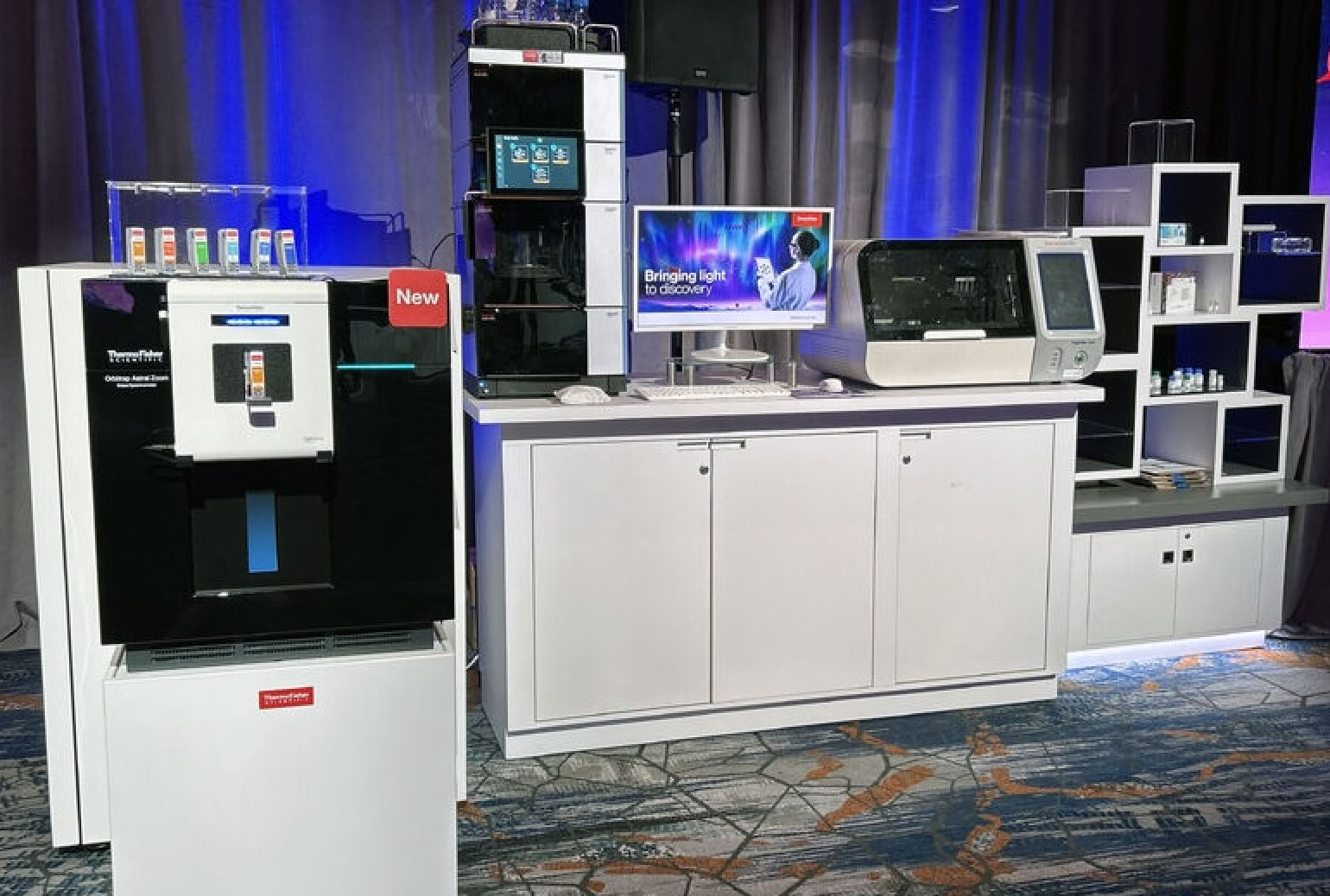
Thermo Fisher Scientific unveil two a top-end Orbitrap mass spectrometers at the American Society for Mass Spectrometry (ASMS) 2026 conference in San Diego — the Thermo Scientific™ Orbitrap™ Excedion™ alongside an improved Thermo Scientific™ Orbitrap™ Tribrid™ Apex. The company also showcased an expanded software stack built around the Olink proteomics platform with the help of the two recently acquired AI/ML companies. It’s the most consequential refresh of Thermo’s Orbitrap line since the original Orbitrap Astral shipped in 2023, and it arrives at exactly the moment Bruker and SCIEX have been narrowing the spectrometer gap rapidly.
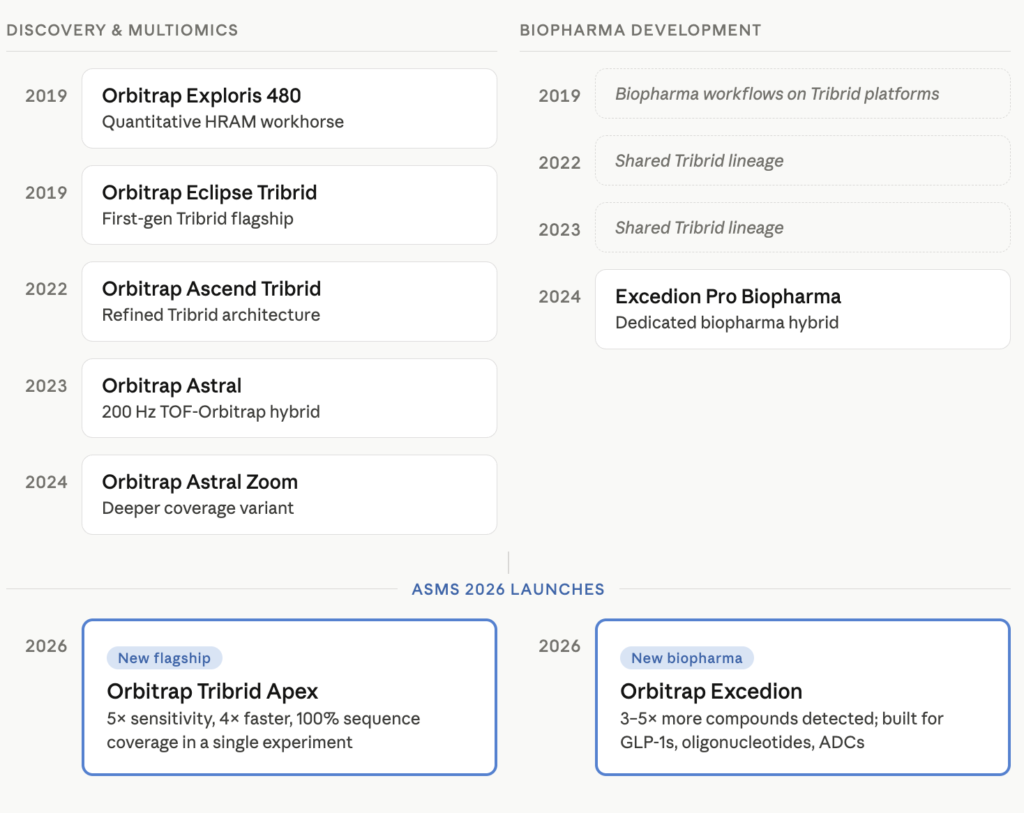
Company claims for the Tribrid Apex are aggressive: five times greater sensitivity, up to 100% sequence coverage in a single experiment, and results up to four times faster than the previous-generation Tribrid (the Orbitrap Ascend / Eclipse family). The Orbitrap Excedion, positioned as a biopharma development platform rather than a discovery instrument, claims it can detect three to five times more compounds in complex samples than its predecessor, the Orbitrap Excedion Pro Biopharma. Both numbers are vendor-supplied and unverified by third parties at launch, but they’re consistent with the magnitude of the step-change the broader Orbitrap line saw when Astral was introduced.
New Changes in the Tribrid Apex
The Tribrid Apex sits at the top of Thermo’s Orbitrap Tribrid line, the company’s flagship architecture combining a quadrupole, a linear ion trap, and an Orbitrap mass analyzer on a single instrument. The line traces back through the Orbitrap Ascend Tribrid (2022) and Orbitrap Eclipse Tribrid (2019) and is the workhorse for the most demanding multiomics, structural biology, and top-down proteomics workflows. The Apex inherits the architecture but, on Thermo’s numbers, delivers a generational jump in both signal and throughput.
The “100% sequence coverage in a single experiment” claim is the one that will get the most attention in proteomics circles. Sequence coverage — the fraction of a protein’s amino acid backbone that gets identified by MS/MS fragments — has historically required multiple acquisitions with complementary fragmentation methods to push past 80–90% on complex biologics. If the Apex genuinely hits 100% in one run on real customer samples, it changes the routine peptide-mapping and biopharma-characterization workflow meaningfully. The “supports more than 300 areas of research” line is marketing, but the underlying point — one instrument doing multiomics, structural biology, biopharma characterization, and small-molecule analysis without a configuration swap — is real and is how Tribrid systems have always been positioned.
Excedion Seems more Interesting and Strategic
The Orbitrap Excedion is the less obvious of the two launches but arguably the more commercially important. Its predecessor, the Orbitrap Excedion Pro Biopharma, was already aimed at pharmaceutical development workflows — peptide mapping, intact mass analysis, host cell protein quantification, glycoproteomic characterization of antibody-drug conjugates. The new Excedion explicitly targets what Thermo’s marketing calls the “new modalities” problem: GLP-1 therapies (Ozempic, Mounjaro, and the wave of follow-ons), oligonucleotide drugs, and antibody-drug conjugates, all of which have introduced analytical complexity that previous-generation biopharma MS systems struggle with.
The “three to five times more compounds detected in complex samples” claim points at this directly. For ADCs, the low-abundance species that determine drug load distribution and conjugation site heterogeneity are exactly the kind of molecules that get missed by lower-sensitivity instruments and become regulatory questions late in development. For oligonucleotide drugs, impurity profiling at the parts-per-million level is the practical bottleneck. For GLP-1 peptide drugs, characterising pegylation profiles and degradation products at clinically relevant concentrations is where the sensitivity matters. The Excedion isn’t a discovery instrument competing with the Tribrid Apex — it’s a regulatory-readiness instrument competing for slots in CMC analytical labs that today might be running multiple legacy systems.
How this stacks up against Bruker and SCIEX
The competitive context for this launch is sharper than it has been in years. Mass spec has historically been a Thermo-versus-Bruker race at the top end, with Orbitraps winning on resolution and TOF instruments winning on scan speed.
Bruker used ASMS 2024 to launch the timsTOF Ultra 2, claiming up to 50% more protein group identifications and 100% more peptides on just 25 picograms of digest — roughly one-tenth the protein content of a single HeLa cell. At ASMS 2025, Bruker followed up with the TimsUltra AIP featuring its Athena Ion Processor, which the company said increased peptide identifications by as much as 35% over the Ultra 2. Bruker’s timsTOF line tops out at a 300 Hz scan rate; the Orbitrap Astral runs at 200 Hz. The Tribrid Apex’s “four times faster” claim is against the previous-generation Tribrid, not the Astral or the timsTOF, and Thermo’s press materials don’t say where it lands on absolute scan speed.
SCIEX, the perennial third player, used ASMS 2025 to launch the ZenoTOF 8600, which the company describes as a 10× sensitivity improvement over the ZenoTOF 7600 and the first SCIEX flagship that’s “more comparable to the Thermo Fisher and Bruker flagships both in terms of performance and price.” That’s a meaningful re-entry into the high-end competitive set — SCIEX had been increasingly positioned as the value option below the Thermo and Bruker flagships, and the 8600 is the company’s attempt to climb back.
The Tribrid Apex and Excedion are best understood as Thermo’s response to this multi-vendor pressure. The Apex defends the high-resolution-plus-versatility end where Orbitrap Tribrids have always been strongest in general. The Excedion claims the regulatory-readiness biopharma slot more aggressively than the Excedion Pro Biopharma did, in a market segment where Waters/Xevo and Sciex are also active. Neither launch is a paradigm shift — the underlying Orbitrap architecture is the same one Alexander Makarov has been refining for two decades — but together they re-establish a generational performance gap at the top of the Orbitrap line that had been narrowing.
The Olink + AI software stack is the quieter, longer-term story
Less visible in the ASMS coverage but probably more strategically important is the software and platform integration story. Thermo acquired Olink in 2024 for $3.1 billion, bringing in the company’s Proximity Extension Assay (PEA) platform — a library of more than 5,300 validated protein biomarker targets that enables high-specificity protein analysis at population scale from minimal sample volumes. At ASMS 2026, Thermo is positioning Olink as the population-scale validation layer that complements Orbitrap-based discovery workflows: discover candidate biomarkers on the Tribrid Apex in a small cohort, then validate them across tens of thousands of samples on Olink. The PRECISE biobank program in Asia, which Thermo is highlighting at the show, is the proof-of-concept for that combined workflow.
The AI and proteoform analysis pieces come from two smaller recent acquisitions — MSAID (machine-learning peptide/protein identification, particularly for previously unidentifiable spectra) and Proteinaceous (proteoform-level analysis, which matters for top-down proteomics and biologic characterization). Neither is a household name, but the strategic point is clear: Thermo is building the same kind of integrated discovery → validation → AI-interpretation stack that competitors will struggle to assemble piecewise, because no other vendor owns both a top-end MS platform and a population-scale targeted proteomics technology.
This is the same convergence playing out across AI-for-bio more broadly. Labcritics has covered the discovery-side moves — Co-Scientist and the Robin/ERA Nature trio, Lila Sciences, Medra.ai, Amazon BioDiscovery, and most recently AbInitio Bio’s foundation models for biomanufacturing. The instrument vendors are doing the same convergence from the hardware end: combining best-in-class measurement with AI/ML software and proprietary biology databases to produce decision-ready data rather than raw spectra.
Is it a Good Time to Upgrade your Laboratory’s Spectrometer?
A few practical things for working analytical chemists and proteomics core directors evaluating this launch:
The 5× sensitivity number needs independent benchmarks. Vendor claims at ASMS are calibrated against the previous-generation instrument under favourable conditions, not against current competitors under standardised workloads. The benchmarks that matter are head-to-head comparisons against the timsTOF Ultra 2/AIP and ZenoTOF 8600 on common samples — those will start appearing in literature and on academic core-facility pages over the next 6–12 months.
100% sequence coverage is a real claim that should be verifiable quickly. This is the kind of specific number that gets tested against actual customer biologics within weeks of installation. Either it holds on routine samples or it doesn’t, and the proteomics community will surface that publicly.
The Excedion’s positioning in CMC labs is the long-tail revenue play. Regulatory analytical workflows are sticky once validated. If the Excedion clears the validation bar at major biopharma development organisations on GLP-1, oligonucleotide, and ADC workflows over the next 18 months, it will be in production for a decade.
The Olink integration story will determine the next 5 years of competitive positioning. The instrument-by-instrument arms race against Bruker continues, but the harder-to-replicate advantage Thermo is building is the combination of MS-based discovery plus PEA-based population-scale validation plus AI-driven interpretation. That’s not something a competitor catches up on through a faster TOF.
For now, the Orbitrap Tribrid Apex and the Orbitrap Excedion are the most credible Orbitrap launches since the Orbitrap Astral family redefined the high end three years ago. Whether they re-open a clear lead over Bruker’s timsTOF line and SCIEX’s revitalised ZenoTOF flagship is the question that the next year of real-world benchmarks will answer.
Read more: SelectScience coverage of the launch | Orbitrap product range on Labcritics | Orbitrap Astral on Labcritics
