BoltzMol-1, BoltzProt-1 and the Boltz API: AI Drug Discovery Goes Full-Stack
The MIT-born co-folding lab just shipped a small-molecule hit-discovery pipeline, a protein-design pipeline, and a production API on the same day — moving from “we predict structures” to “we find your molecules.” Here’s what’s actually new in BoltzMol-1, BoltzProt-1 and the Boltz API, how they stack against the earlier Boltz models, and where they land against AlphaFold3, Chai, and the Baker-lab toolchain.
On June 16, 2026, the Boltz team announced three things at once:
- BoltzMol-1 — its first end-to-end small-molecule hit-discovery pipeline. In what Boltz frames as the largest experimental validation of AI co-folding for small-molecule hit discovery to date, it returned confirmed hits on 6 of 10 hard targets while testing only 28–51 compounds per target.
- BoltzProt-1 — a new de novo protein-design pipeline succeeding BoltzGen. A new protein–protein affinity scorer lets it nearly triple the de novo nanobody hit rate over BoltzGen on hard targets and, per Boltz, beat other leading proprietary models head-to-head.
- The Boltz API — a hosted, agent-friendly way to run BoltzMol-1, BoltzProt-1, and Boltz-2, from $0.025 per prediction, with Python/JS SDKs and first-party plugins for Claude Code, Codex, and Gemini CLI.
The strategic move underneath all three: Boltz is no longer just a structure-and-affinity predictor. It’s positioning as a design-and-discovery engine — generation plus scoring plus delivery — that wants to live inside the tools scientists already use. It’s the same trajectory we flagged when Isomorphic Labs unveiled its IsoDDE drug-design engine: the frontier is shifting from AI as a structural tool to AI as the primary drug-design engine.
How Boltz got here: the model lineage
To judge what’s new, it helps to remember how fast this family has moved. Each release attacked a different bottleneck — a progression we’ve tracked across our AI protein structure prediction coverage.
| Model | Released | What it did | Why it mattered |
|---|---|---|---|
| Boltz-1 | Nov 2024 | First fully open, AlphaFold3-class all-atom structure predictor (proteins, nucleic acids, small molecules in one model) | Democratized AF3-level co-folding under an MIT license; kicked off an open reproduction race |
| Boltz-2 | Jun 2025 | Added binding-affinity prediction to co-folding — first deep-learning model to approach physics-based FEP accuracy, ~1000× faster | Made in-silico screening economically practical; trained on ~5M affinity measurements |
| BoltzGen | Nov 2025 | First generalizable generative binder-design foundation model (proteins, peptides, nanobodies) | ~66% hit rate on 9 novel targets testing ≤15 designs each; open weights + code |
| BoltzMol-1 | Jun 2026 | Small-molecule hit-discovery pipeline | Turns affinity prediction into a target→hit workflow at HTS-beating cost |
| BoltzProt-1 | Jun 2026 | Protein-design pipeline (BoltzGen successor) | Adds a dedicated protein–protein interaction scorer; ~3× BoltzGen’s nanobody hit rate |
| Boltz API | Jun 2026 | Hosted inference for all of the above | Distribution layer; cheaper than self-hosting, built for agents |
The through-line: Boltz-1 solved structure, Boltz-2 solved affinity, and 2026’s pipelines turn those primitives into discovery campaigns. BoltzMol-1 explicitly puts “a version of Boltz-2 optimized for prospective screening” at its core, and BoltzProt-1 borrows Boltz-2’s affinity-modeling philosophy for the protein–protein case. BoltzGen, meanwhile, has already begun showing up inside accessible front-ends — it’s one of the engines behind tools like LiteFold’s democratized protein-research stack. The newest models are, in a real sense, applications of the prediction muscle the lab spent two years building.
BoltzMol-1: small-molecule hit discovery without the high-throughput screen
What it is
BoltzMol-1 is an AI hit-discovery pipeline for finding small molecules that bind a new target. It runs in two modes:
- Rank what’s already buyable from in-stock catalogs, or
- Generate and search an ultra-large, make-on-demand chemical space of more than 74 billion compounds.
You can steer generation toward a desired property profile and run candidates through a new set of ADME models so the molecules that survive are already pointed toward developability — not just raw binders.
The results that matter
Across ten challenging, therapeutically relevant targets — most of them far from anything in the training data — BoltzMol-1 delivered confirmed hits on six, testing only 28–51 compounds per target. Highlights Boltz reported:
- ROR1 (a pseudokinase): binders confirmed across three orthogonal biophysical assays.
- MRGPRX2 and the GLP-2 receptor (GPCRs): multiple new agonists/antagonists and functional small molecules.
- STAT6 (a transcription factor with complex biology): small-molecule binders identified, still being validated as full hits.
- PknB (an essential tuberculosis kinase): compounds with functional activity in both cell-based and biochemical assays.
- LC3B / GABARAP (autophagy proteins, with a Tufts collaboration): functionally active binders relevant to targeted protein degradation.
The economic claim is the headline for industry readers: target to validated hits in 3–8 weeks for a total compute-plus-wet-lab budget of roughly $10–15k. Conventional high-throughput screening (HTS) typically tests tens of thousands to millions of compounds, runs for months, and costs hundreds of thousands of dollars to find a comparable handful of hits.
vs. its predecessor (Boltz-2)
Boltz-2 already proved you could predict small-molecule affinity at near-FEP quality. But Boltz-2 was a scoring model — you still needed your own generation and orchestration. BoltzMol-1 wraps that scorer into a prospective, generative, ADME-aware campaign engine. The conceptual leap is from “tell me how well this molecule binds” to “go find me molecules that bind, and make sure they’re drug-like.”
vs. the competition
| Approach | Strength | Trade-off vs. BoltzMol-1 |
|---|---|---|
| Traditional HTS | Empirical, unbiased, well-trusted | Months and $100k+ per campaign; BoltzMol claims weeks and ~$10–15k |
| Physics-based FEP / FEP+ (Schrödinger) | Gold-standard accuracy for hit-to-lead | Slow and compute-heavy; Boltz-2 (BoltzMol’s core) approaches FEP at ~1000× speed |
| Physics docking (AutoDock Vina, DOCK3) | Cheap, mature, interpretable | Weaker enrichment; struggles with novel pockets and flexibility |
| AlphaFold3 co-folding for ligand discovery | High-quality poses | Pose ≠ ranking; AF3 confidence metrics correlate only weakly with binding; access is restricted |
| GPU-accelerated virtual-screening stacks (e.g., NVIDIA BioNeMo, DiffDock) | Mature infra, generative screening over huge chemical spaces | A toolbox, not a validated end-to-end hit campaign with reported wet-lab hit rates |
The competitive bet is that a fast, learned scorer + a 74-billion-compound generative space + built-in ADME beats both the brute force of HTS and the accuracy-but-slowness of physics — if the experimental hit rates hold up beyond Boltz’s own ten targets.
BoltzProt-1: better scoring is the whole game
What it is
BoltzProt-1 is the de novo protein-design successor to BoltzGen, and Boltz is explicit that the improvement lives mostly in scoring, not just generation. Modern generative pipelines can spit out tens of thousands of candidate binders; the constraint is picking the few worth putting in a lab.
The key new component is Boltz-PPI, a custom protein–protein interaction model trained on structural and patent-derived data to score proposed interactions directly. Most design pipelines rank candidates by structural confidence (think pLDDT, ipTM) — a signal that’s useful but only weakly correlated with whether something actually binds. Boltz-PPI is trained to capture the interaction signal more directly, so the pipeline prioritizes candidates by a criterion closer to experimental success.
The results
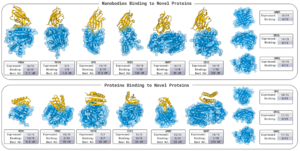
- In de novo nanobody design across ten hard benchmark targets, BoltzProt-1 nearly tripled the hit rate over BoltzGen.
- In head-to-head comparisons against other leading proprietary models, Boltz reports higher success.
- On developability, 58% of BoltzProt-1’s binders passed a stringent multi-criteria panel in full — Boltz says that puts them on par with or ahead of clinical-stage therapeutic nanobodies.
Boltz adds an honest caveat worth repeating: these are not finished therapeutic biologics. BoltzProt-1 doesn’t remove downstream optimization; it gives you a stronger, faster starting point.
vs. its predecessor (BoltzGen)
BoltzGen (Nov 2025) was already a landmark: an all-atom generative model that designed across modalities (proteins, peptides, nanobodies, even small-molecule binders) and hit nanomolar binders on ~66% of nine novel targets while unifying design and structure prediction in one network. BoltzProt-1 keeps that generative backbone but bolts on the dedicated affinity-style scorer (Boltz-PPI) that BoltzGen lacked — the same “add a real affinity signal” move that took Boltz-1 to Boltz-2. The ~3× nanobody hit-rate jump is the payoff.
vs. the competition
This is the most crowded arena in AI protein design. The honest framing: each tool reports on its own targets, with no shared benchmark, so cross-claims should be read with caution.
| Model | Lab / org | Openness | Reported standing |
|---|---|---|---|
| BoltzProt-1 | Boltz (MIT-origin) | API + open lineage | ~3× BoltzGen nanobody hit rate; 58% pass full developability panel |
| Chai-2 | Chai Discovery | Closed/proprietary | ~16% de novo antibody hit rate (≤20 designs, 52 novel targets); ≥1 hit on 50% of targets; ~68% for miniproteins — the proprietary number to beat |
| RFdiffusion / RFantibody | Baker Lab (UW IPD) | Open | Field-defining, but antibody hit rates often <1%; can need hundreds–thousands of designs |
| BindCraft | Pacesa et al. | Open | AF2-hallucination + ProteinMPNN; very high reported success (10–100% by target); widely adopted in pharma |
| AlphaProteo | DeepMind | Closed | Strong high-affinity binders; closed access |
| IsoDDE | Isomorphic Labs | Closed | Reportedly doubles AF3 accuracy on hard protein-ligand benchmarks and is competitive on antibody–antigen — see our IsoDDE breakdown |
Where BoltzProt-1 plausibly differentiates:
- Against the open Baker-lab stack (RFdiffusion/RFantibody): Boltz claims materially higher nanobody hit rates with a single unified model rather than a multi-tool chain.
- Against BindCraft: BindCraft posts eye-catching numbers but on a different (often easier) target mix and is optimized for minibinders; BoltzProt-1 is making the harder nanobody/antibody-style case with an explicit developability gate.
- Against Chai-2, AlphaProteo and IsoDDE: these are the proprietary leaders. Boltz’s pitch is comparable-or-better performance plus the openness and pricing of its ecosystem — the classic open-vs-closed wedge.
The thing to watch: Chai-2’s ~16% de novo antibody hit rate across 52 novel targets is currently the most impressive published proprietary result. Boltz’s “outperforms leading proprietary models” claim will be properly testable only once the BoltzProt-1 technical report’s target list and metrics are scrutinized against Chai’s. The same de novo antibody race is now drawing in cloud and platform players too — see our look at Amazon Bio Discovery’s bid to rewire the antibody pipeline.
The Boltz API: distribution as the real strategy
A model nobody can run cheaply is a paper, not a product. The Boltz API is the layer that makes the other two launches matter at scale.
What’s notable
- Price: as little as $0.025 per prediction — Boltz claims this is cheaper than running the open-source models yourself, because the endpoints are heavily optimized (and powered in part by NVIDIA’s GPU-accelerated kernels, via cuEquivariance).
- Scale + latency: a single call can fan out to thousands of GPUs for throughput, while staying responsive for small queries.
- Built for agents: Python and JavaScript SDKs, plus first-party integration for Claude Code and support for Codex and Gemini CLI. This is the same agentic-science wave reshaping the lab, from DeepMind’s Co-Scientist to coding-agent research collaborators. Boltz says wiring the API into its own internal agents has been a major research accelerant.
- IP terms: you own the inputs and outputs; Boltz says it does not store them to retrain its models.
- Launch credits: $2,000 for every company and $100 for every academic, for the first two weeks.
The partner land-grab
The most strategically interesting part is the day-one distribution: BoltzMol-1 and BoltzProt-1 are natively accessible inside Benchling, Phylo, Amazon Bio Discovery, Rowan, Tamarind, Kiin Bio, Pauling.ai, Mirror Physics, and Cultivarium. Benchling alone puts Boltz in front of a huge slice of the industry’s lab-informatics users. This is a deliberate move to become the default inference backend for biomolecular design before competitors lock in those integration slots.
vs. running it yourself / vs. competitors’ access models
- vs. self-hosting open Boltz models: you trade control for someone else’s GPU economics and zero ops — and Boltz claims the hosted price actually undercuts your own infra.
- vs. AlphaFold3: AF3’s weights were initially restricted to a DeepMind-run server with usage limits, which is exactly the gap the open ecosystem exploited. Boltz is doing the opposite — pushing access out through every partner platform and agent it can.
- vs. Chai / proprietary players: those tend to keep the strongest models behind their own platforms. Boltz’s wager is that open weights + ubiquitous, cheap API + agent-native tooling wins more of the ecosystem than a walled garden, even a high-performing one.
Where this leaves AI drug discovery
A few takeaways for anyone tracking AI for molecular design:
- The frontier is shifting from prediction to discovery. Structure prediction is becoming commoditized (AF3, Boltz, Chai-1, Protenix, HelixFold3 all cluster near the same accuracy). The differentiation is now in generation + scoring + experimental hit rate — which is exactly where BoltzMol-1 and BoltzProt-1 plant their flag, and the same move Isomorphic’s IsoDDE is making on the proprietary side.
- Scoring is the new moat. Both new Boltz pipelines win by improving the ranking step (a screening-tuned Boltz-2 core; the Boltz-PPI interaction scorer). This echoes a broader lesson — generative models overproduce, and the value is increasingly in a learned signal that correlates with the wet lab rather than with structural confidence.
- Open vs. closed is the defining axis. Chai-2, AlphaProteo and IsoDDE set the proprietary performance bar; Boltz, BindCraft, and the Baker-lab stack carry the open banner. Boltz is trying to have it both ways — open model lineage, commercial hosted API, omnipresent distribution.
- The benchmark caveat is real. Every team reports on its own targets. There is still no shared, blinded benchmark for de novo binder hit rates or prospective small-molecule discovery, and prior work has shown co-folding models can lean on memorization. Treat all cross-model “outperforms” claims — Boltz’s included — as vendor-reported until independent evaluation catches up. The two technical reports (BoltzMol-1 and BoltzProt-1) are where the scrutiny should focus.
- Economics is the pitch to industry. “$10–15k and 3–8 weeks to validated hits” and “$0.025 a prediction” are aimed squarely at drug-discovery budget owners. If those numbers survive contact with messy real-world programs, the cost structure of early discovery genuinely changes.
Bottom line
With BoltzMol-1, BoltzProt-1, and the Boltz API, Boltz completed its transformation from an open structure-prediction project into a full-stack, commercially distributed AI drug-discovery platform — small molecules and proteins, generation through scoring, delivered cheaply inside the tools scientists already use. The performance claims are strong and the distribution strategy is aggressive. The open question, as always in this field, is whether self-reported hit rates generalize beyond the curated launch targets. The technical reports and the first wave of independent users over the coming weeks will tell.
Related on Labcritics
- Isomorphic Labs’ New Drug Design Engine Promises to Outdo AlphaFold 3
- Amazon Bio Discovery: Rewiring the Antibody Discovery Pipeline
- Google DeepMind’s Co-Scientist Graduates from Research Demo to Nature Paper
- LiteFold: Democratizing AI-Driven Protein Research and Drug Discovery
- AlphaFold Evolved to Predict Large, Complex Proteins Using Experimental Data
- NVIDIA’s BioNeMo Framework: AI Accelerates Drug Discovery
External sources & further reading
Code to complex: AI-driven de novo binder design — Structure / Cell Press (2025), for RFdiffusion/RFantibody context
Boltz — Announcing BoltzMol-1, BoltzProt-1, and the Boltz API (boltz.bio, Jun 16, 2026); BoltzMol-1 and BoltzProt-1 technical reports
Boltz-2: Towards Accurate and Efficient Binding Affinity Prediction — bioRxiv / PubMed (Jun 2025); MIT CSAIL + Jameel Clinic + Recursion
BoltzGen: Toward Universal Binder Design — bioRxiv (Nov 2025); MIT Jameel Clinic
Zero-shot antibody design in a 24-well plate (Chai-2) — bioRxiv (Jul 2025); Chai Discovery
One-shot design of functional protein binders with BindCraft — Nature (Aug 2025)
De novo design of high-affinity protein binders with AlphaProteo — DeepMind (2024)
Protenix — Advancing Structure Prediction Through a Comprehensive AlphaFold3 Reproduction — bioRxiv (Jan 2025); ByteDance