
New Printing Tech Materializes 3D Objects Inside Living Cells
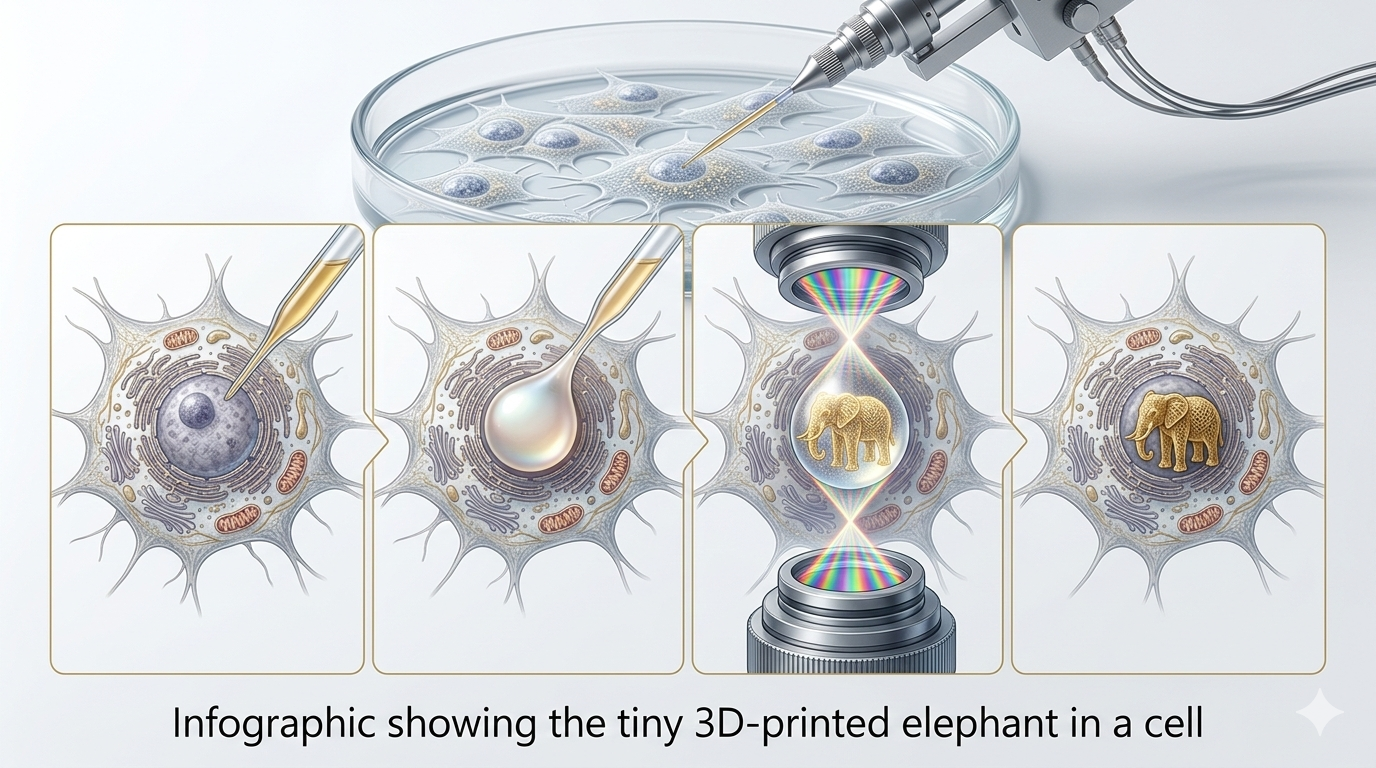
Researchers from Slovenia demonstrate the first successful 3D printing of microscopic structures directly inside living human cells — opening doors to intracellular machines and enhanced cellular engineering and tracking realtime changes.
What do you get when you combine cutting-edge laser technology, a human cell, and a 10-micrometer elephant? The future of bioengineering or a new type of moore’s law that determines how small and complex 3D machines can be built inside human cells.
In a groundbreaking study published in Advanced Materials, researchers from the Jožef Stefan Institute in Ljubljana, Slovenia, achieved something never done before: 3D printing microscopic structures directly inside living human HeLa cells cells. To prove their technique works, they printed a tiny elephant — complete with trunk, legs, and ears — inside a living cell.
This isn’t just a scientific curiosity. It’s an early proof of concept that could revolutionize how we study cells, engineer biological machines, and potentially treat diseases.
From Science Fiction to Reality
Bioengineering has been moving fast. We’ve seen CRISPR gene editing, lab-grown organoids, and brain cells on microchips. But this latest breakthrough takes us into uncharted territory — the interior of a living cell.
“For the first time, we’ve demonstrated that you can print functional 3D structures directly inside a living cell — and the cell keeps living, functioning, even dividing,” explains Maruša Mur, researcher at the Jožef Stefan Institute and co-author of the study.
The implications? Scientists could one day print microscopic machines inside cells to monitor their activity, deliver drugs precisely where needed for example inside cancer cells, or even enhance cellular functions beyond natural limits.
Two-Photon Polymerization
The technique uses two-photon polymerization (TPP) — a sophisticated 3D printing method that treats a photo-sensitive resin with an extremely precise laser.
Here’s the process:
- Introduce the resin: A droplet of biocompatible photoresin is injected into the cell
- Shape with light: A focused laser polymerizes (hardens) the resin into the desired 3D shape
- Remove excess: The unexposed resin dissolves away, leaving only the printed structure
- Cell continues living: Remarkably, the cell remains viable and even continues to divide
The precision is remarkable — structures can be as small as 100 nanometers (that’s 1/10,000th of a millimeter).
What Did They Print?
The team didn’t stop at the elephant. They demonstrated versatility by printing:
- Barcode structures — for labeling individual cells
- Woodpile lattices — geometric frameworks
- Complex 3D shapes — showcasing the technology’s detail capability
The 10-micrometer elephant (about 1/10th the width of a human hair) served as an impressive demonstration of what the technique can achieve.
Why Is This Important?
Cell Mechanics Research
“This provides a new tool to manipulate living cells from the inside,” says Mur. “It enables a new approach to studying their mechanical and biological responses.”
By printing structures inside cells, researchers can now study how cells respond to physical objects, cellular mechanical properties and cell division mechanics
Bioelectronics & Biosensors
Imagine printing tiny sensors inside cells that can monitor pH, temperature, or chemical concentrations in real-time. This technology makes that possible.
Drug Delivery
Precision is everything in medicine. Intracellular 3D printing could enable:
- Targeted drug delivery directly to cell interiors
- Controlled release mechanisms
- Minimally invasive treatments
Cyborg Cells
Perhaps most exciting is the possibility of creating “enhanced” cells with built-in microscopic machines — cells with capabilities beyond what biology alone can provide.
The Road Ahead
This is just the beginning. Current limitations include:
- Printing speed — currently slow for practical applications
- Cell types — only tested on HeLa cells so far
- Structure complexity — still limited to simple shapes
But as the technology matures, we could see personalized cellular therapeutics, real-time cellular monitoring devices and possibly advanced disease treatments.
The Bigger Picture
This breakthrough represents a convergence of multiple fields: materials science, laser physics, cell biology, and micro-engineering. It’s the kind of interdisciplinary innovation that’s driving modern biotechnology forward.
The Slovenian team’s work reminds us that the boundary between biology and engineering is becoming increasingly porous. We’re not just studying cells anymore — we’re beginning to build within them.
Source: Advanced Materials – Two-Photon 3D Printing of Functional Microstructures Inside Living Cells
