Beckman Coulter Life Sciences Launches Biomek i3 Benchtop Liquid Handling System
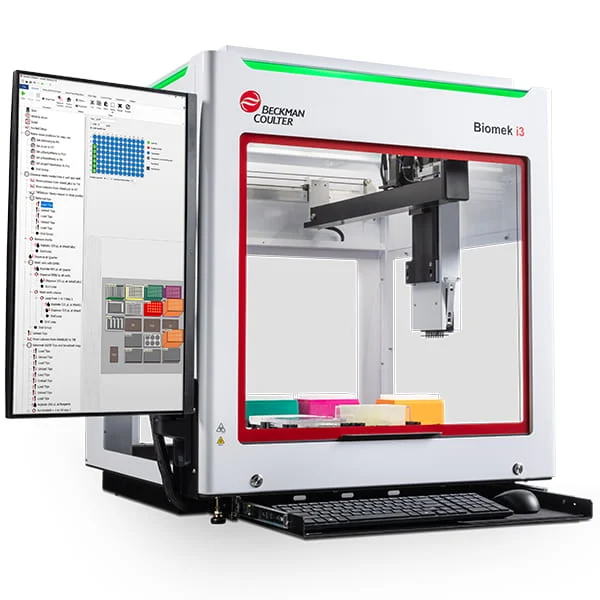
Beckman Coulter Life Sciences has announced the Biomek i3 Benchtop Liquid Handler, expanding its long-standing Biomek automation platform into the low- to medium-throughput segment.
The Biomek i3 is positioned as a compact, cost-conscious automation system intended for research laboratories that require flexibility and reproducibility but lack the physical space, budget, or expertise typically associated with larger automation platforms.
Key specifications highlighted in the launch include:
- Grid-based deck with 15 standard + 5 flex positions
- 8-channel pipetting head with selective tip pickup
- 1–1,000 µL volume range
- Integrated gripper for ANSI/SLAS labware
- On- and off-deck support for heating, cooling, shaking, tilting, and thermocycling
- Touchscreen interface and drag-and-drop protocol design
The system targets genomic and drug discovery workflows, including sequencing, synthetic biology, epigenetics, cell-based assays, and ADME-Tox studies.
The benchtop liquid handling systems is becoming increasingly crowded with new announcements aiming to remove bottlenecks, ease of use, modularity, smaller footprints, and lower barriers to entry. Below is a table of the recent announcements:
| Platform / Vendor | Target Throughput | Deck Capacity & Layout | Pipetting Configuration | Volume Range | Tip Management | Gripper & Labware Handling | On/Off-Deck Device Support | Software & UI | Learning Curve | Customization Flexibility | Regulated / Semi-Regulated Suitability | Typical User Profile |
|---|---|---|---|---|---|---|---|---|---|---|---|---|
| Beckman Coulter Life Sciences Biomek i3 | Low–medium | Grid-based deck with 15 standard + 5 flex positions | Fixed 8-channel head with selective tip pickup | 1–1,000 µL | Selective tip pickup reduces waste | Integrated gripper for ANSI/SLAS plates, lids, tip boxes | Native support for heating, cooling, shaking, tilting, thermocycling | Touchscreen with drag-and-drop workflow design | Low | Moderate (configuration-focused, not script-heavy) | Strong alignment | Small–mid biotech, assay development, labs new to automation |
| Opentrons OT-2 | Low–medium | Open deck, flexible labware placement | Single or 8-channel modules (interchangeable) | Broad, module-dependent | Standard tip usage | No native gripper (third-party solutions required) | Limited native integration; extensible via custom hardware | Python-based scripting (API-driven) | Medium–High | High (open-source hardware & software) | Limited | Academic labs, exploratory research, automation-savvy teams |
| Tecan Fluent Uno | Medium | Fluent-derived deck architecture | Configurable pipetting arms | Broad, application-dependent | Advanced tip tracking and reuse options | Integrated robotic handling | Extensive ecosystem support | Fluent software environment | Medium | High | Strong | Pharma, translational research, scale-up focused labs |
| Agilent Bravo | Low–medium | Compact, fixed deck layout | Fixed multichannel head | Optimized for genomics volumes | Standard tip usage | Limited robotic handling | Strong plate handler and device compatibility | Software-driven protocol configuration | Medium | Moderate | Moderate–Strong | Genomics cores, standardized assay labs |
| Hamilton Microlab STARlet | Medium | Highly configurable deck | Multiple pipetting configurations available | Broad, precision-focused | Advanced tip handling options | Integrated gripper and robotic transport | Extensive peripheral and device support | Venus software (logic-heavy configuration) | High | Very High | Very Strong | Precision-critical, customization-heavy environments |