Spectrometers in Smartwatch Made Possible with Micro-vortices in Thermoplastic Polymers
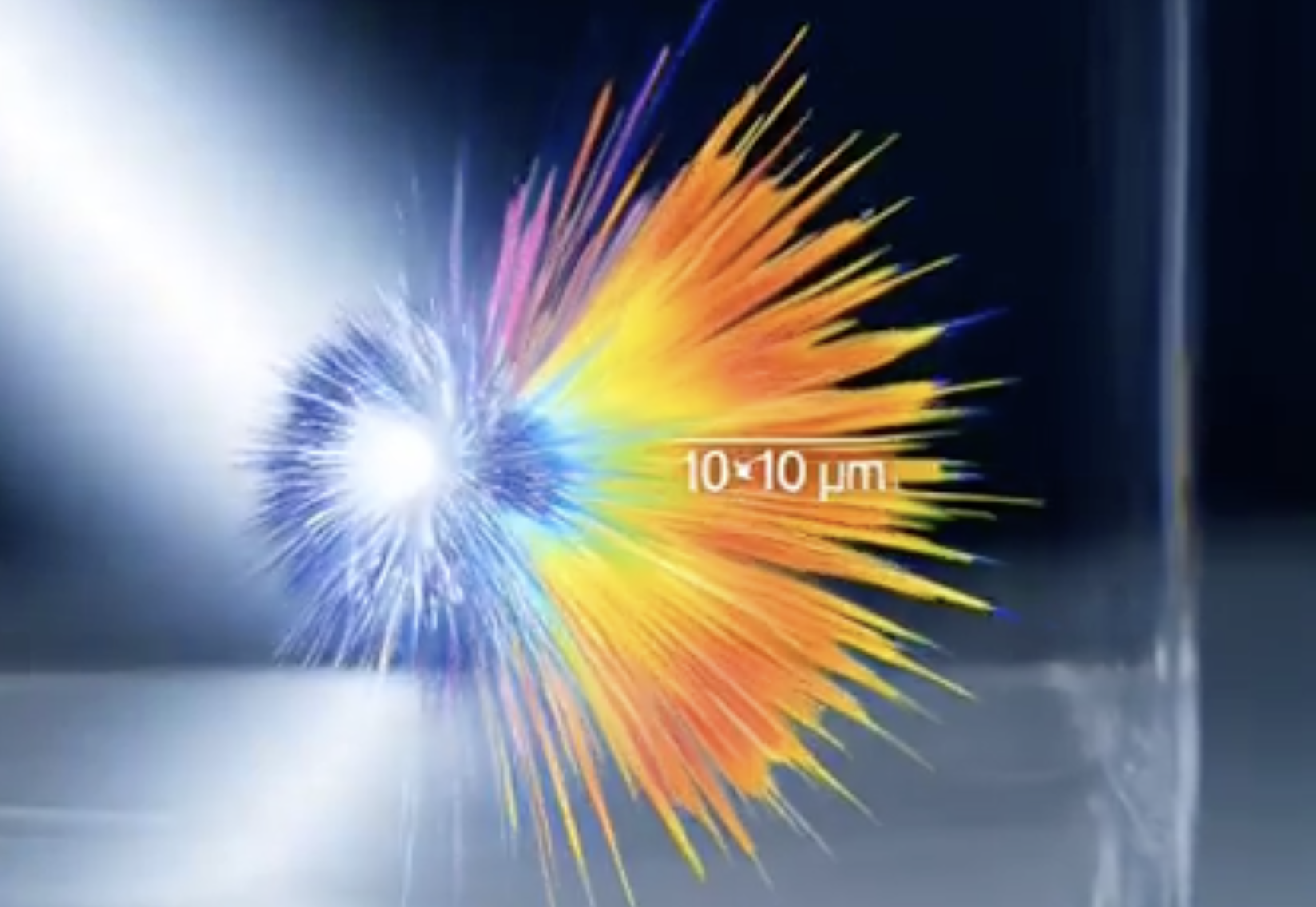
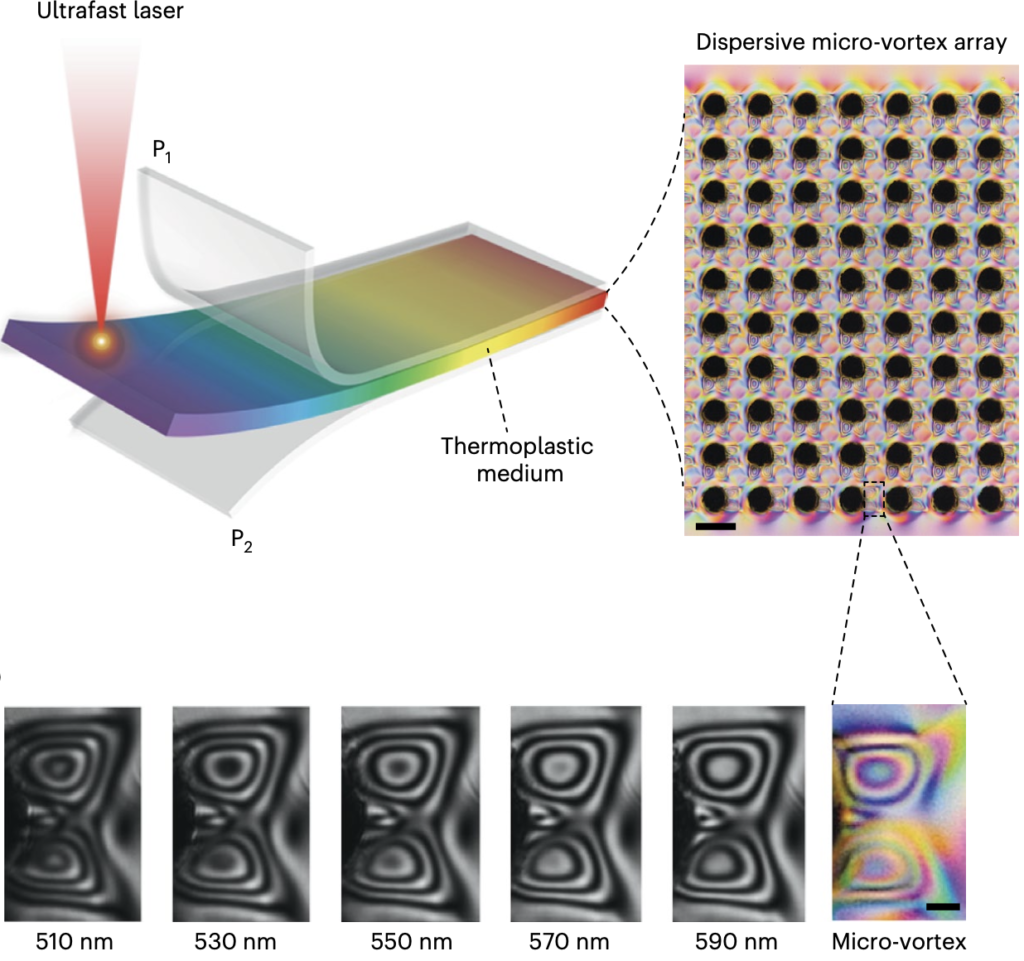
Researchers at College of Optical Science and Engineering, Zhejiang University used an ultrafast laser to write “micro-vortices” — swirl-like structural patterns — directly into polycarbonate (a common thermoplastic polymer). These micro-vortices produce optical dispersion via the photoelastic effect: the laser-induced stress field changes the local refractive index in a spatially complex, wavelength-dependent way, so each wavelength of incoming light gets modulated differently.
Tiny spectrometers — devices that break light into its constituent wavelengths — are needed for things like spectral imaging, optical sensing, and on-chip light analysis. But shrinking a dispersive element (the part that actually splits light into colors) to microscale dimensions has been hard, especially if you want it to produce rich, varied spectral responses without needing external tuning signals (voltage, heat, mechanical stress, etc.).
Core Problem with Current Spectrometers
Spectrometers split light into wavelengths, and shrinking them down to micrometer scale is a long-standing engineering goal — useful for everything from wearable health monitors to hyperspectral imaging chips. But conventional dispersive elements hit hard limits when miniaturized:
Gratings force a trade-off when you shrink them: you either reduce the period or the number of periods, which narrows bandwidth or wrecks resolution, they’re currently stuck at millimeter scale.
Computational spectrometers (the modern alternative) sidestep this by using arrays of small “spectral response units” — photonic crystals, filter arrays, metasurfaces, custom photodetectors — and reconstruct the spectrum mathematically. The catch is that you need lots of distinct spectral response units to get accurate reconstruction, which fights miniaturization. Some groups solve this by tuning units with electricity or heat, but that adds complexity, response time, and power consumption.
The authors aimed to create a single dispersive microstructure that produces many distinct spectral responses simultaneously, with no external stimuli required.
Thermoplastic Disadvantage into a Breakthrough
Thermoplastic polymers like polycarbonate are usually considered bad substrates for precision micro-photonics because they deform during processing. Other groups treat this as something to engineer around. Zhang et al. flip it: they exploit the deformability deliberately, using it to write self-organizing vortex structures via ultrafast laser pulses.
There are also two physics problems with embedding dispersive structures inside a polymer (rather than in air):
- The refractive-index contrast drops because the polymer has n > 1, so traditional micro-photonic structures lose their effect.
- Polymers deform under laser writing, so you can’t make the regular periodic structures most photonics relies on.
The vortex approach uses the photoelastic effect — stress changing the refractive index — instead of relying on regular geometric periodicity, which neatly sidesteps both problems.
How the micro-vortices form
This is the elegant part. The fabrication is a two-shot process per vortex pair:
Shot 1. An ultrafast laser pulse focused inside the polycarbonate causes a micro-explosion. The focal spot vaporizes, creating a central void surrounded by a ring of denser material (the shockwave compresses surrounding polymer outward) and beyond that, a ring of underdense material (where matter was pushed away from). Backscattered electron imaging and Raman spectroscopy confirm this density profile — the C–H stretching peak at ~3,072 cm⁻¹ is enhanced in the dense ring and weakened in the underdense ring.
Shot 2. A second pulse fired nearby drives material to diffuse outward. Here’s the clever bit: that diffusing material crosses into the density-modulated zone created by the first shot. Diffusion is slow through dense regions and fast through underdense regions. The result is a velocity gradient — exactly what nature uses to make vortices in fluids (the paper draws an analogy to ocean eddies). Theory predicts a pair of symmetric vortices form; experiment confirms it.
Optimal spacing: ~1.8–1.9× the radius of the density-modulation zone. Closer or further and the vortex doesn’t form cleanly.
The vortex formation creates strong localized stress concentration. Via the photoelastic effect, this stress produces strong optical anisotropy (birefringence) that varies in space and frequency — and that’s the dispersive signal.
The mechanism follows two strict rules confirmed experimentally:
- Sequence dependence: vortices appear in the underdense zone of a previously irradiated void.
- Direction dependence: vortices orient along the axis from the second to the first irradiation center.
A lot of work still remains but the researchers were able to show that fabrication is deterministic and programmable — you can chain vortices in chosen directions by ordering shots carefully.
This Could Change Spectrometers Forever?
Key performance claims from the abstract:
- Broadband: works from 400 to 1,550 nm (visible through short-wave infrared)
- Tiny footprint: each dispersive element is just 10 × 10 µm²
- Viewing-angle independent (unusual for dispersive micro-optics; metasurfaces and gratings often aren’t)
- No external stimulus needed — it’s a passive structure
- Material-agnostic: works in multiple thermoplastic polymers, not just polycarbonate
- Robust to harsh conditions
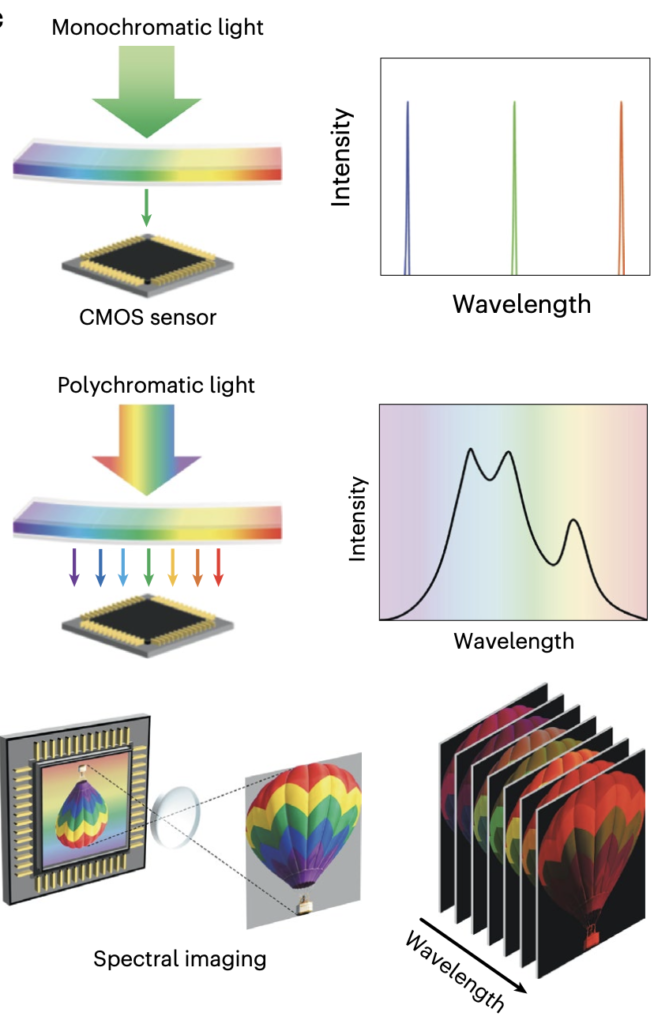
- Integration-ready: they paired it with an image sensor to demonstrate on-chip spectral analysis and high-resolution microscopic spectral imaging
They call the resulting system a DVOS (dispersive-vortex optical spectrometer).
Minituarized Spectrometers Becoming a Reality
Miniaturized spectrometers are a quite popular research area, with nothing commercially available yet. Other recent approaches have included single-nanowire spectrometers (Yang et al., Science 2019), quantum-dot spectrometers (Bao & Bawendi, Nature 2015), metasurface spectrometers, tunable van der Waals junctions (Yoon et al., Science 2022), photonic crystal slabs, and computational spectrometers using plasmonic filters. Each has trade-offs between footprint, bandwidth, resolution, and whether external tuning is required. The above micro-vortex approach is notable because it’s passive, broadband, and compatible with plain thermoplastic substrates — which suggests it could be cheaper and more manufacturable than metasurface or 2D-material alternatives.
References
Zhang, B., Liu, S., Zeng, F. et al. Optical dispersion using micro-vortices in thermoplastic polymers for integrated microspectrometers. Nat Electron (2026). https://doi.org/10.1038/s41928-026-01618-z