AI-Designed Ribosomes Attempt to Strip a Letter From the Alphabet of Life
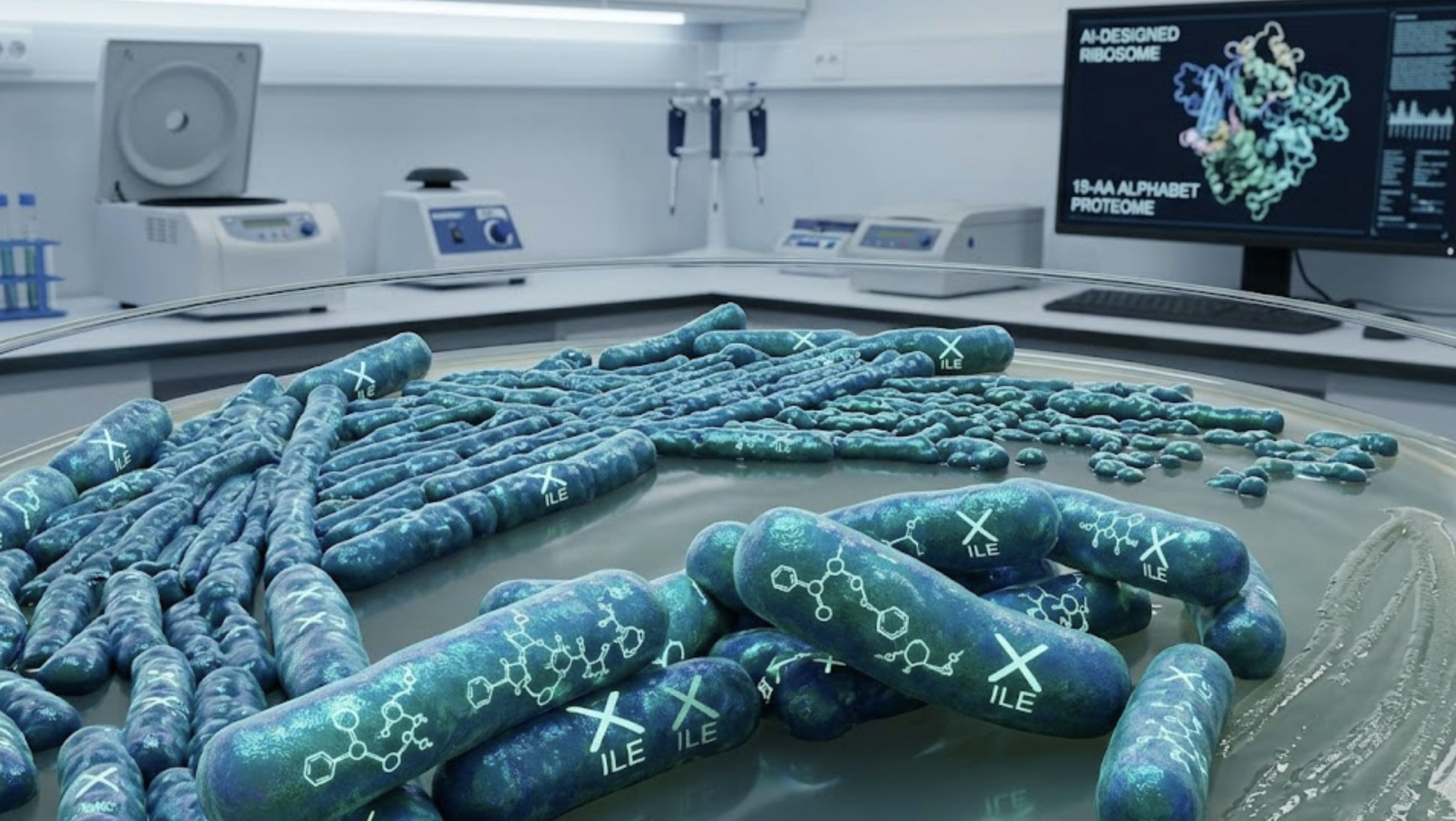
In a study published last month in Science, a team led by Harris H. Wang at Columbia University, with collaborators at MIT and Harvard, used generative artificial intelligence to redesign the entire ribosomal protein complement of E. coli to function without isoleucine — one of the 20 canonical amino acids universal to all known life on Earth. The resulting strain, named Ec19, encodes 21 isoleucine-free ribosomal subunits at a single genomic locus, grows at over 90% of wild-type fitness, and remained genetically stable across more than 450 generations of laboratory evolution. The paper, Toward life with a 19–amino acid alphabet through generative artificial intelligence design, is the most consequential demonstration to date that AI protein-design tools can attack a problem that has resisted brute-force molecular biology for decades.
It is also, by the team’s own framing, a half-step. Ec19 is not a true 19-amino-acid organism. The redesign successfully purged 382 isoleucine residues from the ribosomal proteins — the machinery that builds every other protein in the cell — but the rest of the E. coli genome still contains more than 81,000 isoleucine residues across thousands of other proteins. Wang has been explicit about where this lands: “Like in a video game, we just pushed the ‘skip to the final boss’ button.” For the first time, AI-guided protein design has carried the day on a genome-engineering problem that brute-force biology could not crack alone.
The Experiment: 382 Isoleucines, 52 Ribosomal Proteins, One Bacterium
The setup is conceptually simple but technically vicious. The team picked the E. coli ribosome — the cell’s protein-synthesis machine, composed of 52 essential proteins and the most conserved molecular complex in the tree of life — as their target. The challenge was to rewrite every gene in that ribosome to use only 19 amino acids, removing all isoleucines, while preserving the structure and function of a machine that has been optimised by 3.5 billion years of evolution to do exactly the opposite.
The team followed an iterative design-build-test (DBT) framework:
- Design. Computational protein-design models generated isoleucine-free variants of each ribosomal protein, proposing substitutions and any compensatory mutations needed to preserve fold and function.
- Build. The designed gene variants were synthesised and integrated into E. coli using established genome-engineering techniques — many descended from tools Wang himself helped pioneer, including Multiplex Automated Genome Engineering (MAGE).
- Test. Each redesigned ribosomal protein was validated in vivo by measuring whether the engineered bacterium could still grow.
The naïve baseline, before AI entered the picture, set the difficulty bar. The team first tried a genetic “find-and-replace” — swapping every isoleucine in 39 essential or highly expressed E. coli genes for its closest chemical relatives, valine or leucine. The engineered bacteria survived, but their fitness collapsed to roughly 40% of wild-type — far below the >90% threshold the team had set as a viability target. Better models helped closed the gap.
Why Isoleucine, Why the Ribosome
The choice of isoleucine (Ile) was not arbitrary. Of the 20 canonical amino acids, isoleucine is chemically most similar to valine — both are branched-chain, hydrophobic, comparable in size. If any letter of life’s alphabet was going to turn out to be redundant in principle, isoleucine was the most plausible candidate.
The choice of the ribosome was the harder one. The ribosome is universal: every living organism on Earth uses essentially the same one, decoding mRNA into protein at near-flawless fidelity. Pick any other protein complex and the bar is lower — get the ribosome wrong, and the entire cell stops working in a single step. By targeting it, the team was making a deliberate worst-case bet: if the AI design pipeline could rebuild this, it could probably rebuild anything or even the entire organism, which we assume will be next in line.
The AI Stack: A Composite of Four Models
The redesign engine is the most quietly significant part of the paper. The team did not rely on a single foundation model. They composed a pipeline of four:
- ESM2 — Meta AI’s protein language model. Trained on millions of natural protein sequences, ESM2 suggested evolutionarily plausible substitutions that a simple chemistry-based swap would have missed.
- MSA Transformer — uses multiple sequence alignments to model coevolutionary signals across homologous proteins, identifying compensatory mutations.
- AlphaFold2 — DeepMind’s structure prediction model, used to verify that redesigned sequences would fold into the correct three-dimensional shape. Labcritics covered AlphaFold’s evolution toward experimentally-anchored protein design last year.
- ProteinMPNN — the Baker lab’s inverse-folding model, used to generate sequences likely to fold into specified backbones with high designability.
In practice, this meant the sequence-based models (ESM2, MSA Transformer) proposed candidate isoleucine-free variants, and the structure-based models (AlphaFold2, ProteinMPNN) acted as a downstream filter — checking that each candidate would actually fold correctly and assemble into a functional ribosomal complex. In a handful of stubborn cases, the AI pipeline did not solve the problem; the team resorted to brute-force experimental scanning, replacing each amino acid in turn until a working combination was found.
The end result: every individual ribosomal protein was successfully rewritten. Combined into a single E. coli genomic locus, 21 of the 52 redesigned ribosomal subunits operated together as a functional unit at >90% of wild-type fitness.
Where This Sits in the Recoded-Genome Lineage
The Ec19 result is not the first attempt to alter the genetic code of a living organism — it is the latest, and arguably the most ambitious yet, in a lineage that traces back fifteen years:
- 2011 — Isaacs et al. (Science) demonstrated genome-scale codon replacement in E. coli, converting all 314 UAG stop codons to UAA.
- 2013 — Lajoie et al. (Science) created the first genomically recoded organism, freeing one codon for reassignment to a non-canonical amino acid.
- 2016 — Wang et al. (Nature) and the broader Genome Project-Write consortium (Boeke, Church et al., Science) laid out a programme for synthesising entire genomes from scratch.
- 2019 — Fredens et al. (Nature) at the MRC Laboratory of Molecular Biology produced Syn61, an E. coli strain with a fully synthesised, 61-codon genome — eliminating three of the standard 64 codons.
- 2010 → 2016 — JCVI synthetic cells. Craig Venter’s team built JCVI-syn1.0, the first cell with a fully synthetic genome, and later JCVI-syn3.0, a “minimal cell” with the smallest genome of any autonomously replicating organism. (Venter’s death in late April 2026 fell, by coincidence, within days of the Science paper’s publication.)
What separates Ec19 from this lineage is the method. Previous recoding work was, at heart, a triumph of DNA synthesis, recombineering, and high-throughput selection. Ec19 is the first major recoded-organism result where the bottleneck-breaking insight came from an AI design pipeline, not a wet-lab technique. As Imperial College synthetic biologist Tom Ellis told Scientific American, the paper is “a tour de force of synthetic biology to address a really interesting question that’s fundamental to the origin of life on Earth.”
Why This Matters: Three Genuinely Different Reasons
The mainstream press has converged on “AI shrinks life’s alphabet,” which is broadly correct but flattens three quite distinct stakes.
1. The origin-of-life question. Why did life on Earth converge on 20 amino acids? Is the number a frozen accident — a starting condition that became impossible to back out of once the ribosome became universal — or is it a hard biochemical constraint? Ec19 begins to answer this in the only way the question can be answered: by showing that, with enough engineering effort, the alphabet is not actually frozen. The companion Science Perspective by Sanfiorenzo and Wang — “Can AI simplify the alphabet of life?” — frames this as a fundamental shift in what synthetic biology can interrogate.
2. Genetic isolation and biocontainment. An organism whose genetic code differs from the rest of life’s is, in principle, genetically isolated — it cannot easily exchange functional DNA with natural organisms, and it is much harder for natural viruses to infect. This is the strategic rationale that has driven the recoded-organism field for fifteen years: virus-resistant industrial strains for bioproduction, genetically-firewalled GMOs, and biocontainment for engineered organisms intended to escape the lab safely.
3. Off-Earth and resource-constrained biotech. Ellis suggested that this work could eventually inform biotechnology in environments where not every amino acid is freely available — including, eventually, planetary surfaces where Earth’s amino-acid set may not all be synthesisable from local feedstocks. This is a long-horizon claim, but it is the kind of horizon synthetic biology has historically rewarded.
What This Is Not
Several caveats matter, and the authors are notably careful about them:
- Ec19 is still a 20-amino-acid organism. The ribosomal proteins are isoleucine-free; the rest of the proteome is not. The cell’s tRNAs still load isoleucine. Wang and colleagues purged 382 isoleucines; >81,000 remain.
- Some redesigns required brute force. In cases where the AI design models failed, the team fell back on experimental scanning. The AI pipeline is a force-multiplier, not a complete solution.
- Fitness above 90% is not parity. A real production-scale recoded organism would need to match wild-type E. coli not just in growth rate but in long-term genetic stability, stress tolerance, and yield under industrial conditions. Some independent reporting puts the engineered strain’s growth at roughly 60% of wild-type in certain conditions, depending on which subset of redesigns are integrated.
- The path to a true 19-amino-acid cell is harder, not easier, from here. Many of the remaining isoleucines in E. coli sit in proteins less conserved than the ribosome, but in far greater numbers and across networks of interactions that current AI models do not yet capture as well as protein structure alone.
How This Fits the Broader AI-for-Biology Moment
Ec19 lands in a stretch of weeks that has redrawn the map of AI-in-life-sciences. In April 2026, OpenAI launched GPT-Rosalind, its first domain-specific reasoning model for biology and drug discovery. AWS launched Amazon Bio Discovery, an agentic platform tying biological foundation models to wet-lab CROs. Companies like Lila Sciences and Medra.ai are building autonomous, design-build-test labs where AI hypothesis generation and robotic experimentation operate in a closed loop.
The Liu et al. paper is the academic counterpart to all of that — proof that the same architecture (composable AI models orchestrating an iterative DBT loop) works at the bench, not just on a slide deck. Where GPT-Rosalind is positioned as a reasoning layer for pharma R&D and Bio Discovery is positioned as an antibody-design platform, Ec19 is a single, completed experiment showing what the same toolset can do on the hardest end of synthetic biology: rewriting the universal code.
It is worth noting which models drove the result. AlphaFold2 (DeepMind), ProteinMPNN (Baker lab, University of Washington), ESM2 and MSA Transformer (Meta AI) — none of them designed primarily for amino-acid-substitution problems, none of them sold as commercial products. The most consequential AI-bio infrastructure of 2026 is, in large part, still the open-weights and open-source models the academic community built between 2021 and 2024.
Open Questions
- How well does this generalise? The team picked the most conserved protein complex on Earth as a single target. Will the same pipeline work as cleanly on more variable, less constrained protein families? Or did ribosomal proteins’ deep evolutionary record actually give the language models a richer training signal than less-conserved targets would offer?
- What does the AI pipeline cost per design success? Brute-force baseline succeeded ~43% of the time. The AI-augmented pipeline succeeded much more often, but the paper’s economics of compute vs wet-lab iteration is a question other groups will want to answer before adopting the same stack.
- Can the same approach reach a true 19-amino-acid cell? Wang has publicly committed to extending this from the ribosome to the entire proteome. The remaining ~81,000 isoleucines are not all in conserved machinery. Many are in proteins where AI structural models have less to go on.
- Where do genomic language models fit? Wang has flagged that a truly stripped-down organism will likely require “genomic language models trained on whole genomes rather than just proteins.” That is a different model architecture than anything currently in production — one that several labs and well-funded startups are now racing to build.
- Biosafety. A recoded organism is, by design, harder for natural viruses to infect — but it is also a novel biological entity whose dual-use implications run in both directions. The recoded-organism community has historically been thoughtful about this. As AI design tools make recoding faster and cheaper, the governance conversation gets harder, not easier, including for the trusted-access approaches now being taken by OpenAI and others.
Outlook
Three things stand out about Ec19 that will matter beyond the headline.
First, the AI did not replace the biology — it removed the bottleneck. Without ESM2, MSA Transformer, AlphaFold2, and ProteinMPNN, the team’s brute-force baseline ran out of fitness budget at 40% of wild-type. With them, the same DBT loop reached >90%. That gap is the experimentally measurable contribution of generative AI to a wet-lab synthetic-biology programme — possibly the cleanest such number published to date.
Second, this is a roadmap paper as much as a result paper. As UC Irvine’s Chang Liu observed, its value to the field is partly in giving the community “a kind of roadmap and a sense of the technical challenges in getting to a 19-amino-acid bacterium.” Several groups will now run at the remaining proteome with the same toolkit.
Third, synthetic biology and AI-bio are no longer parallel fields. The same week OpenAI was launching a frontier reasoning model for drug discovery, the same week AWS was launching Bio Discovery for antibody design, and the same month Craig Venter’s Human Longevity launched a $599 consumer genome — a Columbia lab quietly shipped the first major demonstration that AI design pipelines can rewrite the universal code of life at the most conserved point in the cell. Each of these announcements lands in a different commercial register. Read together, they describe a single trajectory.
Twenty amino acids encoded every protein in every organism on Earth for 3.5 billion years. The question of whether that number is final has been speculative for the entire history of the field. As of Science 392, p. 487, it is empirical.
Reachout to Researchers with Our Extensive Marketing Network
Modern scientific marketing partner built for life science brands