
Roche AXELIOS 1 Review Against the High-Throughput Pack
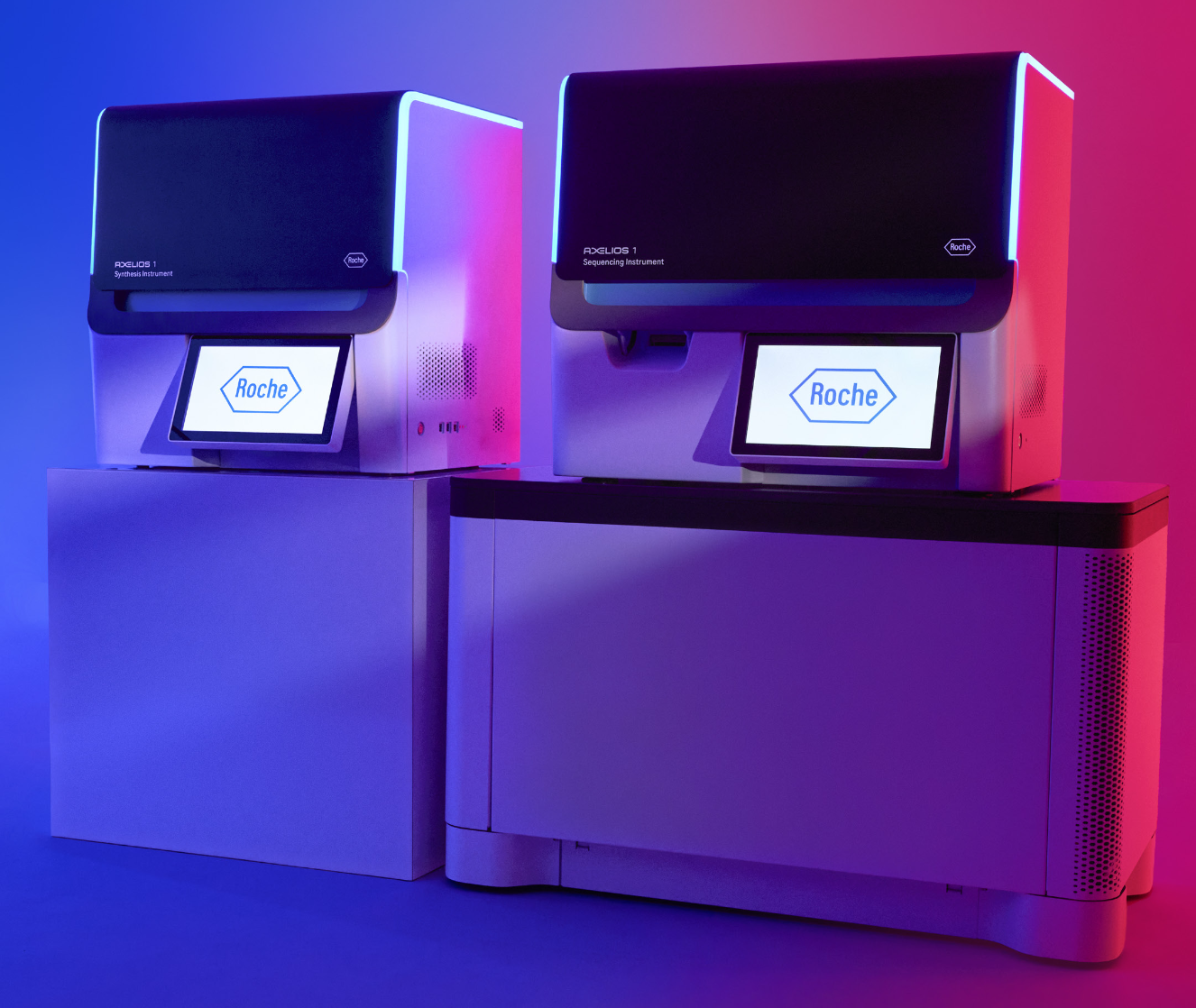
Roche launched the AXELIOS 1 platform yesterday, moving its sequencing-by-expansion (SBX) technology from years of early access at sites like the Broad and Hartwig into general commercial availability. The headline claim is speed with accuracy: a whole human genome the same day, at roughly Q38 duplex accuracy, for about $150 in reagents. The subheader is that AXELIOS 1 undercuts Illumina with a sub $750k next generation sequencer.
But “is it better than Illumina?” is the wrong question, because the platforms are tuned for different things. This article takes AXELIOS 1 apart variable by variable — chemistry, architecture, speed, throughput, read length, accuracy and error profile, cost, ecosystem, and regulatory status — and lines each one up against the platforms it competes with: Illumina’s NovaSeq X Plus, Element Biosciences’ VITARI, Ultima Genomics, and MGI’s DNBSEQ. Long-read systems (PacBio, Oxford Nanopore) are treated separately, because they answer a different question entirely.
One caveat sits above everything below: AXELIOS 1 launched days ago, VITARI has not yet shipped to external users, and Ultima’s newest generation is relatively unproven. Almost every performance number here is vendor-stated, measured under optimised conditions, and not yet reproduced by neutral third parties. Where independent data exists (mostly early-access concordance studies), it is flagged as such. Labcritics has not benchmarked any of these systems (we intend to, as soon as we get our laboratories setup). Treat the tables as a map of claimed positioning, not a scoreboard.
SBX’s Three Mode Sequencing
Conventional short-read platforms use sequencing by synthesis (SBS): they build a complementary DNA strand one labeled base at a time, pausing to image after each chemical cycle. Synthesis and detection are welded together, which caps speed.
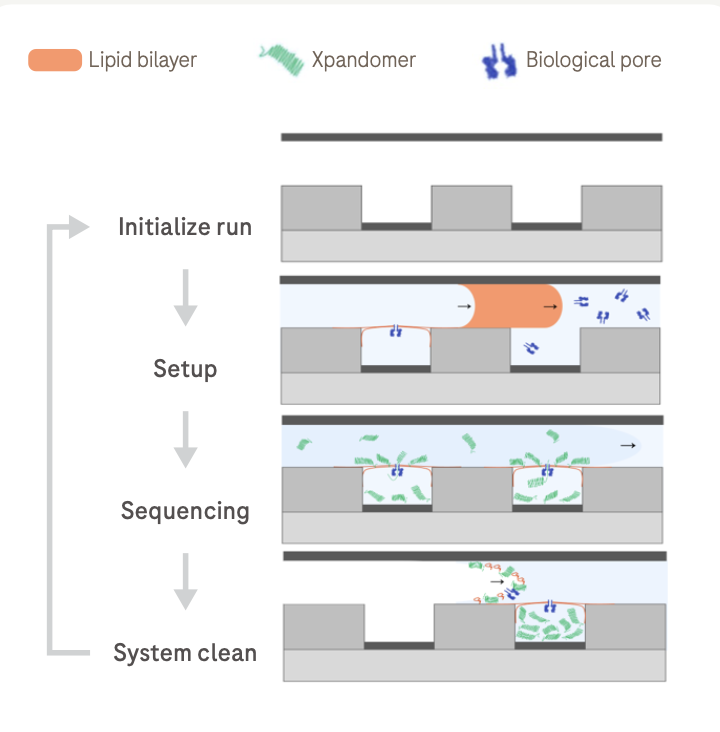
SBX breaks that coupling. A first instrument transcribes each DNA library into an Xpandomer — a synthetic surrogate strand about 50× longer than the original, carrying high-contrast reporter codes spaced along its backbone. A second instrument then threads those Xpandomers through millions of biological nanopores on a reusable silicon sensor (an 8-million-well array, of which roughly 7.3 million pores are typically active in the first 20 minutes) and reads the codes as electrical signal. Because reading is decoupled from chemistry, the sensor runs continuously — and basecalling, duplex consensus, and mapping happen in parallel with data generation, not after it.
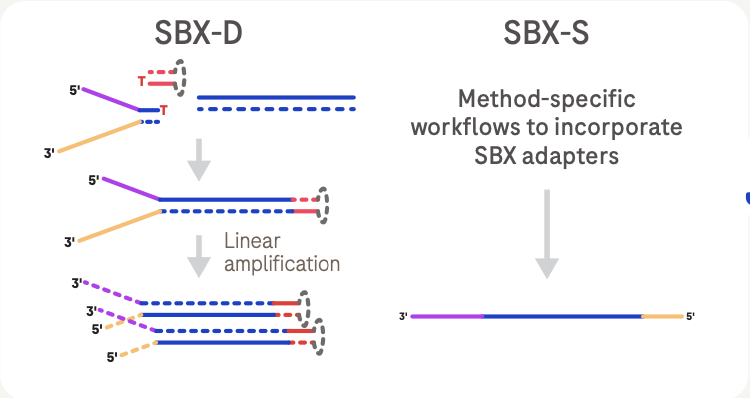
Crucially, AXELIOS runs in three modes from the same hardware, and they occupy different points on the accuracy/throughput/length curve:
- SBX-Duplex (SBX-D) links both strands of a fragment via a hairpin so each base is read twice. This is the high-accuracy mode (~Q38 concordant) used for germline WGS. Inserts are short, ~230–260 bp.
- SBX-Simplex (SBX-S) reads a single strand: lower accuracy (~Q20–Q22) but higher read counts and much longer reads, up to ~1,500 bp under the right prep.
- SBX-Fast is an amplification-free duplex workflow for rapid WGS — a single sample to VCF in under five hours, a trio in under eight — at the cost of high DNA input (~2 µg).
Understanding these modes is essential, because a spec sheet number means little without knowing which mode produced it. Most comparisons below use SBX-D, the mode Roche positions against Illumina.
Comparison 1 — Technology, architecture and reads
| Variable | Roche AXELIOS 1 | Illumina NovaSeq X Plus | Element VITARI | Ultima UG100/UG200 | MGI DNBSEQ-T7 |
|---|---|---|---|---|---|
| Chemistry | Sequencing by expansion (SBX) | XLEAP-SBS (synthesis) | Avidity (Avidite chemistry) | Mostly-natural sequencing | DNA nanoball + cPAS |
| Detection | Nanopore, electrical (reads Xpandomers) | Optical imaging | Optical imaging | Optical imaging (open wafer) | Optical imaging |
| Architecture | Two instruments; synthesis decoupled from reading | Single instrument; coupled cycle | Single instrument | Single instrument | Single instrument |
| Read type | Short-insert duplex (paired strands) | Paired-end short read | Paired-end short read | Single-end | Paired-end short read |
| Consumable model | Reusable silicon chip (~20 runs); pores formed in situ | Single-use patterned flow cell | Single-use flow cell | Wafer | Single-use flow cell |
The architectural outlier is AXELIOS on two counts: it is the only nanopore-based system here (yet, importantly, not a native long-read nanopore platform — it reads a synthetic proxy, not native DNA), and it is the only one with a reusable sensor rather than a single-use flow cell, which is central to its cost story.
Comparison 2 — Throughput and speed
| Variable | Roche AXELIOS 1 (SBX-D) | Illumina NovaSeq X Plus | Element VITARI | Ultima UG100/UG200 | MGI DNBSEQ-T7 |
|---|---|---|---|---|---|
| Output per run | ≥1.8 Tb per ~4 h | ~16–21 Tb per dual flow cell | ~3 Tb (10B reads) | Very high (wafer-scale) | Multiple Tb per run |
| Genomes/run (30×) | ~16 | up to ~128 | ~30 | tens | tens |
| Genomes/day | ~64 (4 queued runs, ~36 h) | ~64–128 (one ~2-day run) | tens | tens | tens |
| Time to result | <24 h lib-to-BAM (16 genomes); SBX-Fast <5 h/sample | ~24–48 h at max output | ~36 h (2×150) | ~20+ h | ~24 h |
| Analysis timing | Real-time, during the run | Onboard DRAGEN, post-run | Post-run | Post-run | Onboard, primary |
Read this table carefully, because it contains the single clearest structural difference between the platforms. On raw per-run throughput, Illumina wins comfortably — ~128 genomes in one run versus AXELIOS’s ~16. On time-to-result, AXELIOS wins decisively — same-day genomes and a sub-five-hour fast mode against Illumina’s roughly two-day maximum run. The two systems reach a similar daily genome count by opposite routes: many small fast runs versus one enormous slow batch. Which is better depends entirely on whether your workflow can keep a giant flow cell full or benefits from fast, frequent, smaller runs.
Comparison 3 — Read length, accuracy and error profile
This is the section most spec sheets flatten into a single misleading Q-number. Accuracy is not one variable; it is at least three — the quality score, how it’s measured, and what kind of errors dominate.
| Variable | Roche AXELIOS 1 | Illumina NovaSeq X Plus | Element VITARI | Ultima UG100/UG200 | MGI DNBSEQ-T7 |
|---|---|---|---|---|---|
| Read / insert length | 230–260 bp duplex; up to ~1,500 bp simplex | 2×150 bp typical | PE75 / PE150 (PE300 planned) | single-end, ~hundreds bp | up to 2×150 bp |
| High-accuracy quality | ~Q38 concordant duplex (per-read ~Q39) | ≥Q30 for most bases (XLEAP improves) | AVITI-class: ≥90% Q40, ≥70% Q50 (UltraQ) | improved gen-on-gen | high, ~Q30-class |
| Lower-accuracy / raw mode | ~Q20–Q22 simplex | n/a (single mode) | n/a | n/a | n/a |
| Dominant error type | Micro-indels > substitutions | Substitutions (very low indels) | Substitutions, low overall | Indel-leaning | Substitutions, low duplication |
| Homopolymer handling | Weak point historically (>15–20 bp); improving | Strong | Strong | Weak point | Strong |
Two things deserve emphasis. First, a Q-score from one chemistry is not interchangeable with a Q-score from another. AXELIOS’s Q38 is a concordant duplex figure — two strands agreeing — whereas Illumina’s is a raw per-read distribution and Element’s is measured against its own avidity chemistry. Comparing the bare numbers is apples to oranges. As one clinical group put it, above roughly Q30–Q35 the practical difference for many variant-calling tasks is small, and what actually matters is downstream variant-call accuracy, not the headline Q.
Second, the error profile differs in a way that affects real workflows. Illumina’s errors are overwhelmingly substitutions, with indels roughly ten times rarer — a profile that decades of tools assume. SBX (like Ultima) leans the other way, with more micro-indels than substitutions, which is why long homopolymer runs (beyond ~15–20 bp) were historically a weak spot and why the choice of variant caller matters more; Roche reports DeepVariant handles these reads better than a generic GATK pipeline. Early-access work has been encouraging — Hartwig reported high concordance with Illumina on indels, structural variants, copy-number variation and tissue-of-origin, and one clinician was pleasantly surprised by homopolymer accuracy — and reported small-variant F1 scores land around 99.6–99.8% for SNVs and 99.4–99.6% for indels. But this is exactly the kind of claim that needs broad, independent replication across sample types before it can be taken as settled.
Comparison 4 — Cost, ecosystem and status
| Variable | Roche AXELIOS 1 | Illumina NovaSeq X Plus | Element VITARI | Ultima UG100/UG200 | MGI DNBSEQ-T7 |
|---|---|---|---|---|---|
| Instrument list price | ~$750,000 | ~$1.25M (X Plus) / ~$985K (X) | ~$689,000 | sub-$1M (UG200) | region-dependent |
| Reagent cost / 30× genome | ~$150 (duplex) | ~$200 | ~$100 | ~$80 | low (region-dependent) |
| Cost per Gb (approx) | ~$1.25 | ~$1.6 | ~$1 | ~$0.7–1 | low |
| Bioinformatics | XOOS (open source) + DeepVariant + NVIDIA Parabricks | DRAGEN (proprietary, onboard) | Cloudbreak + partners | proprietary + partners | MGI pipelines |
| Sample types (now) | gDNA, FFPE, cfDNA, single-cell RNA (10x) | broadest catalog, all types | RUO range | RUO range | RUO range |
| Roadmap | bulk RNA, target enrichment, methylation, proteomics (Olink) | continuous | PE300, Dx | new chemistries | new instruments |
| Regulatory status | RUO | RUO + clinical/IVD pathways | RUO (AVITI Dx in EU) | RUO | RUO (region-dependent) |
| Maturity / installed base | New; early-access data only | Vast; clinically entrenched | Pre-shipping (VITARI) | Growing | Established outside US |
On cost, AXELIOS lands in the middle of an aggressive pack — cheaper per genome than Illumina, dearer than Element and Ultima — but its lower instrument price and reusable chip help the total-cost-of-ownership case. (For how steep the broader cost curve has become, clinical-grade consumer whole-genome sequencing now sells for about $599.) The reusable silicon chip is a genuinely different consumable model: rather than selling flow cells pre-loaded with pores that carry an expiration date, Roche puts a bare silicon chip on the machine and forms the pore bilayer in situ, reusing the chip up to 20 times to spread its cost. Whether that translates into the promised economics in routine use — including cleaning, carryover and chip-lifetime effects — is one of the biggest open questions.
Two ecosystem points cut in opposite directions. In AXELIOS’s favor: its XOOS analysis suite is open source, a real philosophical contrast to Illumina’s proprietary DRAGEN, and it ships with DeepVariant and NVIDIA Parabricks support. Against it: Illumina’s moat is not the instrument but everything around it — a vast catalog of validated library preps, mature pipelines, an enormous installed base, and existing clinical/IVD pathways. AXELIOS is RUO-only today, with a newer (though fast-growing, via KAPA library prep, the 10x single-cell collaboration, and an Olink proteomics tie-in) ecosystem.
The long-read platforms answer a different question
PacBio’s Revio (HiFi long reads) and Oxford Nanopore’s PromethION (native long-read nanopore) are often named in the same breath but solve different problems: structural variants, phasing, full-length isoforms, and repetitive regions that short inserts cannot resolve. AXELIOS’s mid-range simplex reads and RNA/single-cell support may nibble at a few applications where many short-to-mid reads beat fewer very long ones, but SBX does not replace true long-read sequencing. Short-insert versus long-read is a methodological choice, not a head-to-head spec race — and a lab serious about SVs or phasing will still want a long-read platform alongside whatever short-read workhorse it picks.
What we still don’t know
- Independent, like-for-like benchmarks. Nearly all figures here are vendor-stated. The most valuable missing data is neutral, matched-sample comparisons — especially of variant-call accuracy (which matters more than raw Q) across platforms.
- Real running costs. Reagent list prices omit library prep, labor, instrument amortization, and — for AXELIOS specifically — the true economics of the reusable chip over its 20-run life.
- Performance across hard sample types. Degraded, low-input, FFPE and cfDNA samples separate platforms. Early signals (Centogene’s dried-blood-spot rare-disease work, Hartwig’s concordance) are promising but narrow.
- Clinical translation. AXELIOS is RUO today. Roche’s clinical intent is obvious, but any diagnostic claim is future-tense until cleared.
Bottom line
AXELIOS 1 is not built to out-throughput the NovaSeq X Plus or undercut Ultima on price. Its distinct architecture — decoupling synthesis from measurement and reading expanded surrogate molecules through a reusable nanopore sensor — buys a real, structural advantage in speed and flexible batch sizes that SBS, avidity and nanoball platforms cannot match the same way. Its accuracy is competitive but must be read in context: a duplex-concordant Q38 with an indel-leaning error profile closer to Ultima than to Illumina, strong early concordance data, and a homopolymer caveat that is improving.
Whether that package justifies adopting a brand-new, RUO-only ecosystem over Illumina’s entrenched, clinically validated one is a question each lab must answer for its own workflow and sample mix. The most defensible verdict today is narrow: SBX is a genuinely novel, fast, accurate short-insert method with credible early data and an open analysis stack — and, like every platform it launched alongside, its real-world standing relative to rivals still awaits independent benchmarking.
Editorial note: All figures are paraphrased from manufacturer materials and conference/trade reporting (Roche, Illumina, Element Biosciences, Ultima Genomics, MGI; GenomeWeb and specialist sequencing analysts); no source text is reproduced verbatim. Comparative performance figures are vendor-stated and, except where early-access concordance data is named, not independently verified by Labcritics. Quality scores are not directly comparable across chemistries. AXELIOS 1 is for research use only. Internal links point to related Labcritics coverage (Qitan vs Oxford Nanopore, PacBio Vega, Illumina MiSeq i100, Human Longevity’s $599 genome, and Thermo Fisher’s ASMS 2026 Orbitrap/Olink lineup); confirm each resolves before publishing.
