OpenScience vs. Claude Science: Two Takes on the AI Science Workbench
Reachout to Researchers with Our Extensive Marketing Network
Modern scientific marketing partner built for life science brands


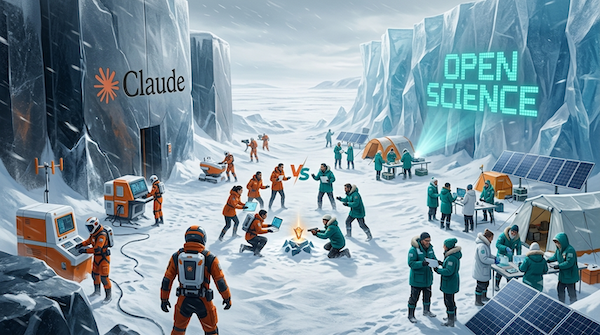
Two “AI workbenches for scientists” launched within a week of each other: Claude Science (Anthropic) is a proprietary app built around Claude models, whereas OpenScience (by Synthetic Sciences) is an open-source alternative to Claude Science. OpenScience is a model-agnostic project that runs a similar workflow on whatever model researchers’s choose. Both AI workbench for scientists aim to pull the scattered pieces of computational research — literature, code, analysis, figures, write-up — into a single environment. The meaningful differences come down to openness, model choice, ease-of-use, repeatability, cost, and how much is handled for you.
Cost, Openness, models, and access
OpenScience is designed to work with Claude, GPT, Gemini, and open-weight models (GLM, Kimi, DeepSeek) or a local fine-tune models run with Ollama, switchable per request from a selector in the workspace. You bring your own API keys, which stay on your machine. Claude Science runs only on Claude models (Opus 4.8 and the current lineup); Anthropic is explicit that it isn’t a new science-specific model, just a workflow layer on top. The trade-off: OpenScience gives you choice, but its own documentation notes that output quality depends heavily on which model you route to, with recommended models currently being ChatGPT and surprisingly Claude is one of the recommended models. Whats also interesting is Claude is one of the 5 contributors to the OpenScience project.
Anthropic’s most powerful public model, Claude Fable 5, drew criticism for refusing routine biology questions — mitochondria, cell membranes, mRNA vaccines — under conservative biosecurity safeguards. The Verge documented it in hands-on testing, and Anthropic confirmed the choice was deliberate, saying it opted to “be overly conservative with our safeguards so they block most queries tied to biology work.” One shared benchmark quantified it: running MMLU and MMLU-Pro against the API, the author reported Fable refusing 93–100% of standard biology-coursework items (97% on MMLU-Pro biology, 104/107) — with queries such as “is there a genetic basis for schizophrenia?” being declined — while the same items sent to Opus 4.8, Sonnet 4.6, and Haiku 4.5 drew zero refusals. Anthropic has called the restriction temporary, with unrestricted access planned for vetted researchers. The takeaway for a lab is exposure — a single-vendor tool inherits that vendor’s safety posture. Claude Science runs on Opus 4.8, which that same test showed answering these questions, so it avoids this particular block; but the episode is a big reason some researchers now want to choose their own model, and OpenScience’s model-agnostic design is the direct hedge.
Access and cost follow from this. Claude Science is bundled into paid Claude plans (Pro, Max, Team, Enterprise; Team and Enterprise need an admin to enable it) and is in beta — cost is predictable but gated behind a subscription. OpenScience needs no account to start and is free to use with your own LLM keys. An optional managed layer, Atlas, offers curated models billed from a prepaid wallet, but the tool works fully without it.
Ease of Setup
OpenScience installs from npm (npm install -g @synsci/openscience, then run openscience) or via npx; building from source needs Bun 1.3+. It starts a local server and opens a workspace in your browser.
Claude Science runs locally on macOS or Linux, or on a remote machine over SSH or an HPC login node, so it can meet you where you already work. If you already have a paid plan, setup is essentially enabling the app.
Both are designed to keep heavy data on your own infrastructure, however queries and results will be shared with the model unless a local model is running everything behind. The local model will be preferred by medium and larger companies who prefer to maintain privacy of data.
What’s inside: agents, skills, and artifacts
The two architectures are similar with a coordinating agent with domain specialists and a review layer. Claude Science pairs a project-manager-style coordinating agent with specialist sub-agents and a dedicated reviewer agent. OpenScience ships a default research agent plus biology, physics, and ml specialists, critique and literature-review sub-agents, and a read-only “plan mode” for reviewing an approach before it runs.
On breadth, OpenScience lists 250+ editable skills across ML, biology, chemistry, and physics, and exposes scientific databases (UniProt, PDB, Ensembl, ChEMBL, PubChem, arXiv, OpenAlex, and others) as agent tools. Claude Science includes 60+ curated skills and connectors for genomics, single-cell, proteomics, structural biology, and cheminformatics, plus integration with NVIDIA’s BioNeMo toolkit (Evo 2, Boltz-2, OpenFold3). The counts measure different things: OpenScience emphasizes breadth and editability; Claude Science a smaller, curated, supported set with specialized integrations ready on day one.
Both render science inline rather than as plain text — 3D protein structures, genome tracks, chemical structures, and plots. Claude Science adds in-line annotation of figures and manuscripts, plus plain-language figure edits (e.g. “change this axis to log scale”) that the agent applies by editing its own code. In genomics and proteomics, the underlying data still comes off real instruments — the sequencers and mass specs our catalog and buying guides cover.
Reproducibility, compute, and data
Both track provenance. Claude Science attaches to each figure the code, environment, a plain-language description, and the message history that produced it, and lets you fork a session to compare approaches. OpenScience stores sessions, artifacts, and provenance on disk as shareable links.
Claude Science treats compute as a first-class feature: it drafts a plan, asks before using new resources, and lets you review or revoke before it submits a job to your HPC cluster (over SSH) or to Modal. OpenScience includes cloud-compute skills, and Atlas adds managed compute, but you handle more of the orchestration yourself.
On security, both keep sensitive data local. One point OpenScience states plainly: its agent is not sandboxed and its permission system isn’t an isolation boundary, so it recommends running inside a container or VM. Claude Science builds in an approval step before reaching new resources.
Integrity and extensibility
Claude Science’s reviewer agent checks citations and calculations and flags figures that don’t match their code — with the caveat, which Anthropic notes, that it uses the same underlying model rather than an independent checker. OpenScience offers critique and literature-review sub-agents plus plan mode. Neither replaces human review or wet-lab validation; for context on how hard these tasks still are, OpenAI’s LifeSciBench found the best model cleared only about a third of real research tasks.
On extensibility, OpenScience is the more open platform — LSP, MCP servers, plugins, custom agents, and a TypeScript SDK, with per-project config. Claude Science lets you save pipelines as reusable skills and add connectors, but within a closed product.
Ease of use: the two interfaces
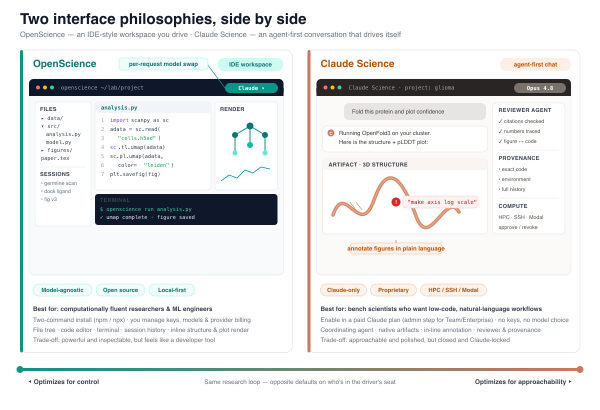
OpenScience presents an IDE-style browser workspace — file tree, code editor, terminal, and session history, with structures and plots rendered inline and a model selector in the toolbar. It’s immediately legible if you’re comfortable in something like VS Code, but it looks and works like a developer tool.
Claude Science leads with an agent-first conversation — you describe what you want in plain language, artifacts render alongside the chat, and you annotate figures in-line to iterate. It’s a gentler on-ramp for someone who’d rather not write code, with no model or key setup to do.
In short: for a bench scientist who wants natural-language, low-code workflows, Claude Science is the easier starting point; for a computationally fluent researcher who wants control, model choice, and editable tooling, OpenScience fits better.
At a glance
| Dimension | OpenScience | Claude Science |
|---|---|---|
| Vendor / license | Synthetic Sciences · Apache 2.0, open source | Anthropic · proprietary |
| Models | Any provider or local fine-tune, switchable per request | Claude models only |
| Access | No account to start; free with your own keys (optional paid Atlas layer) | Paid Claude plan (Pro/Max/Team/Enterprise), beta |
| Install / run | Via terminal: npm or npx; local server + browser workspace | App on macOS/Linux, or over SSH / HPC login node |
| Skills & tools | 250+ editable skills; databases as agent tools | 60+ curated skills and connectors |
| Specialized models | Whatever you route to | NVIDIA BioNeMo — Evo 2, Boltz-2, OpenFold3 |
| Agents | research + biology/physics/ml + critique + plan mode | Coordinating agent + specialists + reviewer agent |
| Compute | Cloud skills; Atlas adds managed compute | Plans, approvals, HPC/SSH, Modal |
| Reproducibility | On-disk sessions/artifacts/provenance, shareable links | Per-artifact code + environment + history; session forking |
| Security | Not sandboxed; run in a container/VM for isolation | Approval step before reaching new resources |
| Extensibility | LSP, MCP, plugins, custom agents, TypeScript SDK | Save pipelines as skills; add connectors |
| Interface | IDE-style browser workspace | Agent-first chat with native artifact rendering |
| Best suited to | Computationally fluent researchers and ML engineers | Bench scientists wanting low-code workflows |
Bottom line
The two tools make different trade-offs rather than competing head-to-head. Claude Science gives up model choice and open-source inspectability in exchange for a polished, low-setup environment with strong compute handling and curated integrations. OpenScience gives up out-of-the-box polish and day-one specialized tooling in exchange for an open, model-agnostic platform that runs free on your own keys.
If you already pay for Claude and want to ask questions and get figures without managing models or clusters, Claude Science is the simpler choice today. If you value vendor independence, cost control, model flexibility, or the ability to read and edit the tooling, OpenScience is worth a look — with the caveats that it’s young and puts more operational work on you.
One thing to keep in mind for both: they help most with the early, computational stages of research. Any headline demonstrations are early-stage and not yet independently validated, and the built-in reviewers rely on the same underlying models, so wet-lab work and peer review remain the real checks.
Related on Labcritics
- OpenAI Enters the AI-Bio Arms Race with GPT-Rosalind
- LifeSciBench: OpenAI’s Hard New Life-Science Benchmark
- Google DeepMind’s Co-Scientist Reaches a Nature Paper
- BoltzMol-1, BoltzProt-1 and the Boltz API
- Labcritics Buying Guides · Products & Pricing Catalog
- OpenScience Github
Sources: Anthropic’s Claude Science announcement; Synthetic Sciences’ OpenScience documentation; The Verge’s hands-on testing of Claude Fable 5’s biology safeguards; and reporting from MarkTechPost, TechRadar, MIT Technology Review, and others (June–July 2026). Specifics reflect two early-stage products and may change.