The Rise of the One-Person Pharma Company
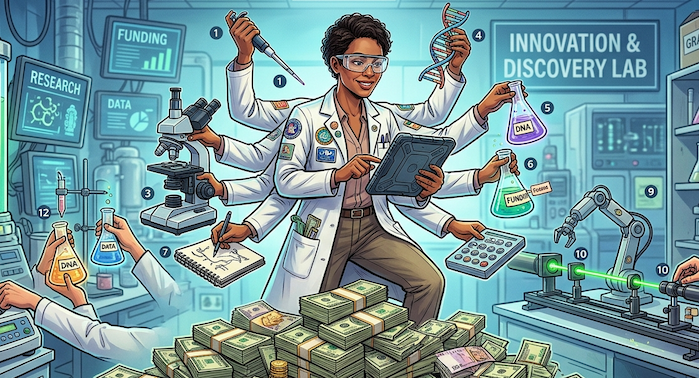
AI can now design a molecule, a cloud lab can make and test it, and a regulatory on-ramp exists to put it into a patient. The pieces of a pharma company that once needed thousands of people are collapsing onto a single desk — opening doors for a one-person pharma company.
In early 2017, a Boston neurologist who had never designed a drug in his life set out to build one for a single child. Timothy Yu of Boston Children’s Hospital had just helped diagnose a young girl named Mila Makovec with a one-of-a-kind mutation causing Batten disease, a fatal neurodegenerative disorder. There was no treatment, and at fewer than a handful of known patients there was no market to justify one. So Yu’s lab designed a bespoke antisense oligonucleotide — a short strand of synthetic genetic code tailored to Mila’s exact mutation — validated it in her own cells, had it manufactured, cleared the FDA, and dosed her. From first contact to first injection took roughly ten months. The drug, milasen, was the first medicine in history designed for one specific person.
Milasen was hand-built by a specialized team with hospital resources and, by one accounting, a development cost around $1.6 million — a rounding error against the roughly $985 million median cost of bringing a conventional drug to FDA approval, but hardly the work of a lone individual. What has changed in the years since is the toolchain around it. The scientific steps that made milasen extraordinary in 2018 — design a therapeutic molecule, make it, test it, and shepherd it toward a patient — are each being pulled into software, automated infrastructure, and standardized regulatory pathways. Put those pieces together and a provocative question comes into focus: how small can a pharma company get? At the limit, could it be one person?
The Company of One Comes for Biology
The idea of a one-person company is not something new, it has been seen repeatedly in software. OpenAI’s Sam Altman has said his group chat of tech CEOs keeps a betting pool on the year the first one-person billion-dollar company appears — something he framed as previously unimaginable without AI. Anthropic’s Dario Amodei has suggested it could arrive as early as 2026. The trend line is visible in the data: according to Carta figures cited by Forbes, the share of startups founded by solo founders has nearly doubled since 2015. History offers precedents from the pre-AI era — Instagram sold to Facebook with 13 employees; the dating site Plenty of Fish ran on essentially one person while turning millions in profit — and 2025–2026 produced fresh ones, including a solo-built AI agent that OpenAI acquired within months of its release.
That thesis crossed into biology in early this year in the most unlikely form: a dog. Paul Conyngham, a Sydney machine-learning engineer with no background in biology, was told his rescue dog Rosie had only months to live from aggressive mast cell cancer after surgery and chemotherapy failed. Rather than accept the prognosis, he paid roughly A$3,000 to have her healthy and tumour DNA sequenced at the University of New South Wales, used ChatGPT to map out a plan and AlphaFold to pinpoint mutated-protein targets, then partnered with UNSW’s RNA Institute to manufacture a bespoke mRNA cancer vaccine tailored to her tumour. Within roughly two months of her first injection, her largest tumour had shrunk dramatically. Sam Altman, who met Conyngham, marvelled that the chatbots had let an individual act with something close to the power of a research institute — the clearest illustration yet of his own thesis, and it came from a pet owner, not a company. UNSW called it the first personalised cancer vaccine ever designed for a dog.
Software, though, is forgiving in ways biology is not. Code compiles or it doesn’t; a molecule can pass every in-silico filter and still fail in a cell, or harm a patient. The “one-person pharma” thesis is therefore not that a single founder will casually mint a drug from a laptop, but something narrower and more interesting: that the minimum viable team for creating a real therapeutic is shrinking fast, because each layer of the pipeline is being productized into something a very small group — or an individual orchestrating a fleet of tools and services — can operate. It is worth walking through those layers, because each is now real.
Layer one: Designing the Molecule
The hardest scientific step — designing a molecule that does what you want — is the one AI has transformed most visibly. Knowledge is no longer gatekept. DeepMind’s AlphaFold cracked structure prediction; a wave of open generative tools then made design accessible. RFdiffusion, BindCraft, ProteinMPNN, ESMFold and ColabFold now let a researcher generate novel protein binders, fold them, and filter candidates computationally, often on free or cheap cloud GPUs. On the small-molecule side, generative chemistry models design drug-like compounds from scratch, and platforms like ADMET-AI screen millions of them for developability — absorption, distribution, metabolism, excretion, toxicity — in hours.
How far this has come was on display in Adaptyv Bio’s crowdsourced protein-design competitions. In one submission, a team from the startup Cradle designed an EGFR binder with roughly eight times the affinity of a marketed antibody — reportedly in about half an hour of hands-on work while the platform ran overnight. A later Adaptyv challenge targeting the Nipah virus glycoprotein drew over 650 participants who submitted more than 10,000 designs, with dozens reaching single-digit-nanomolar affinity against a target that had almost no prior binder work. The winning strategies leaned on the same handful of open tools now available to anyone.
The frontier is consolidation: instead of stitching a dozen open models into a pipeline, AI-native drug-discovery platforms increasingly bundle folding, docking, de novo generation, and molecular-dynamics simulation into a single interface. Emerging platforms in this category — including India-built entrants such as LiteFold — aim to put an end-to-end computational discovery workflow in a browser tab, no cluster required. At the very frontier, Alphabet’s Isomorphic Labs now frames AI as the primary drug-design engine rather than a structural tool. The practical effect is that molecular design, once the exclusive province of well-funded medicinal-chemistry departments, is becoming a skill a motivated individual can wield.
Layer two: making and testing it — without a bench
Designing a molecule is useless if you can’t make it and see whether it works. This is where the “order and deliver” part of the story lives, and it is less appreciated than the AI hype.
Cloud labs turn wet-lab work into an API call. Emerald Cloud Lab operates a facility of more than 200 networked instrument types that a scientist controls remotely through software; you write a protocol, robots and technicians execute it around the clock, and the data comes back to you wherever you are. Researchers, in the company’s framing, simply order experiments online. Strateos pioneered a similar model (before pivoting to private deployments), Arctoris runs a remote-operated CRO platform, and Carnegie Mellon opened what it called the first academic cloud lab. Companies like Adaptyv Bio extend the same logic to proteins specifically: submit a sequence, and they synthesize and functionally test it — measuring real binding by SPR — then return the numbers.
Stitch AI onto that infrastructure and you approach a closed loop. A widely noted collaboration between Carnegie Mellon and Emerald produced Coscientist, a GPT-4-based system that designs and plans experiments and emits ready-to-run code in the cloud lab’s own language. Antibody-engineering companies such as LabGenius run robotic, machine-learning-driven “closed-loop” platforms that reportedly designed and characterized thousands of multispecific antibodies in a matter of weeks; newer entrants like Medra.ai are chasing the fully autonomous “self-driving lab”, and cloud-native platforms such as Amazon’s Bio Discovery now knit data, model selection, and CRO-run wet-lab testing into one agentic loop. The through-line: a researcher no longer needs to own a laboratory, hire technicians, or even be on the same continent as the experiment. The bench has become a cloud service.
Manufacturing at clinical grade — the GMP step — remains the province of specialized contract manufacturers (CDMOs), but that too is an outsourced service a small sponsor can buy rather than build. Yu’s team, notably, identified contract research organizations to manufacture milasen and run its safety testing; they did not build a factory.
Layer three: delivering a medicine for one
The most striking part is that the endpoint — an actual therapeutic in an actual patient — already has working templates for the individualized case. Mass drugs with clinical research backing, not so much for now.
Milasen proved the scientific and regulatory path for an n-of-1 drug. The n-Lorem Foundation, founded in 2020 by Ionis Pharmaceuticals founder Stanley Crooke, has since turned that one-off into a repeatable model: it discovers, develops, and provides experimental antisense medicines to “nano-rare” patients — those with mutations shared by no more than a few dozen people worldwide — and pledges to supply them free, for life. Crucially, the U.S. FDA has built an on-ramp, issuing a suite of draft guidances from 2021 covering the clinical, nonclinical, manufacturing, and administrative expectations for individualized ASO products developed by a single sponsor-investigator. A modality once improvised case by case now has documented rules of the road.
Antisense oligonucleotides are the leading edge here for good reasons: they are, relatively speaking, cheap and fast to design, they target genetic mutations with high specificity, and — because their chemistry is well characterized — regulators can reason about a new sequence by analogy to approved ones. That combination is exactly what makes them the first plausible product for an ultra-lean drug developer. The design step is increasingly AI-assisted; the synthesis is outsourced; the regulatory template exists; and non-profits have shown the delivery model. Each rung of the ladder that milasen had to invent now has a standard part.
The Honest Limits
None of this yet adds up to a literal one-person pharma company, and it is worth being clear-eyed about why. Cost has fallen dramatically but not to zero: a bespoke clinical drug trials program still runs on the order of a million-plus dollars, which for most patients means substantial fundraising or a foundation’s backing.
Safety and liability do not compress the way software does — an error in a legal contract is recoverable; an error in a molecule injected into a child’s spinal fluid is not. GMP manufacturing, toxicology, and clinical oversight remain genuinely hard, genuinely regulated, and genuinely staffed by experts. The n-of-1 model works best for a specific class of genetic disease and a specific modality; it does not obviously generalize to, say, a novel small-molecule oncology drug requiring large trials. However, it can open opportunities for our one-person pharma company to form partnerships and fund further testing.
And the “one person” framing obscures how much of the work is really a network: the individual scientist is surrounded by cloud labs, contract manufacturers, foundations, treating physicians, ethicists, and regulators. As critics of the solo-unicorn thesis point out, high-stakes judgment and human trust resist automation — and in medicine the stakes are life and death, not a churned subscription. The more accurate picture is not one person replacing a company, but one person coordinating what used to require one, with AI agents and outsourced infrastructure absorbing the mechanical middle.
Why this Matters for Asian Researchers
For researchers in India and across Asia, the shift is not abstract. The traditional barrier to therapeutic innovation has been infrastructure: you needed a discovery department, a wet lab, a manufacturing relationship, and regulatory expertise before you could even begin. The layers described above dissolve much of that barrier. A researcher at a university in Bengaluru or Hanoi or Jakarta can now access the same open design models, rent the same cloud-lab time, order the same functional testing, and outsource production to the same contract manufacturers as a scientist at a large pharma — and increasingly do so through AI-native platforms built in the region itself.
That is precisely where the opportunity and the responsibility meet. The rare-disease burden in Asia is enormous and under-served, and the n-of-1 approach is tailor-made for exactly the patients large pharma will never reach. But accessing this toolchain requires fluency in it — knowing what RFdiffusion can and cannot do, how to design a cloud-lab protocol, what an FDA (or CDSCO) individualized-therapy pathway demands. The rate-limiting factor is no longer capital equipment; it is capability. Community efforts — from open training to AIxBio hackathons that put these tools in researchers’ hands — are beginning to close that gap. Building that capability across the region’s research institutes is the work that turns a Silicon Valley thought experiment into medicines for the patients who need them most.
The one-person pharma company does not fully exist yet. But the direction of travel is unmistakable: the unit of drug creation is shrinking, from the thousand-person enterprise toward the small team, and eventually toward the individual scientist with a laptop, a cloud lab, and an army of AI agents. Mila’s drug took a hospital and ten months. The next one may take far fewer people — and reach far more patients.
Related on Labcritics
- LiteFold: Democratizing AI-Driven Protein Research and Drug Discovery
- CRADLE-1 Seeks to Rewrite the Economics of Protein Engineering
- BoltzMol-1, BoltzProt-1 and the Boltz API: AI Drug Discovery Goes Full-Stack
- Isomorphic Labs’ New Drug Design Engine Promises to Outdo AlphaFold 3
- AlphaFold Evolved to Predict Large, Complex Proteins Using Experimental Data
- Medra.ai and the Future of AI Drug Discovery
- Amazon Bio Discovery: Rewiring the Antibody Discovery Pipeline
- OpenAI Enters the AI-Bio Arms Race with GPT-Rosalind
- Evolved 2025: Hackathon for Accelerating AI Breakthroughs in Healthcare & Life Sciences
Sources
- Sam Altman on the one-person billion-dollar company — Fortune, “Sam Altman wants AI to create a one-person unicorn” (fortune.com/2024/02/04/sam-altman-one-person-unicorn-silicon-valley-founder-myth/); Forbes, “The Billion-Dollar Company Of One Is Coming Faster Than You Think” (forbes.com/sites/markminevich/2025/08/20/); Forbes, “OpenAI Called The One Person AI Startup And Three Founders Proved It” (forbes.com/sites/sandycarter/2026/04/04/).
- Milasen / n-of-1 therapy — C&EN, “Milasen: The drug that went from idea to injection in 10 months” (cen.acs.org/business/Milasen-drug-idea-injection-10/97/i42); Boston Children’s Hospital, “Milasen: Genetic diagnosis to custom drug, in under 1 year” (answers.childrenshospital.org/milasen-batten-disease/); NEJM 2019, “Patient-Customized Oligonucleotide Therapy for a Rare Genetic Disease” (DOI:10.1056/NEJMoa1813279); Science, “Drug tailored to one girl with brain disease” (science.org).
- N-of-1 cost and regulatory context — “Preparing for Patient-Customized N-of-1 Antisense Oligonucleotide Therapy” (PMC11275492); FDA draft guidances on Individualized ASO Drug Products, 2021 (fda.gov — CMC, clinical, nonclinical, administrative).
- AI-assisted personalised cancer vaccine (Rosie) — The Conversation, “A man used AI to help make a cancer vaccine for his dog – an oncologist urges caution” (theconversation.com/a-man-used-ai-to-help-make-a-cancer-vaccine-for-his-dog-an-oncologist-urges-caution-278735); corroborated by Fortune (fortune.com/2026/03/15/) and MedicalXpress (medicalxpress.com/news/2026-03-ai-cancer-vaccine-dog-oncologist.html).
- n-Lorem Foundation — Nature Medicine, “Personalized antisense oligonucleotides ‘for free, for life'” (nature.com/articles/s41591-023-02335-2); nlorem.org.
- Cloud labs and self-driving labs — The Scientist, “How Cloud Labs and Remote Research Shape Science” (the-scientist.com); PNAS, “The automated lab of tomorrow” (pnas.org/doi/10.1073/pnas.2406320121); Emerald Cloud Lab (emeraldcloudlab.com); Coscientist review, R. Soc. Open Sci. (royalsocietypublishing.org); LabGenius / self-driving labs (scispot.com).
- Protein-design democratization — Adaptyv Bio EGFR and Nipah competitions and “Lessons from the protein design competition” (adaptyvbio.com/blog); Cradle, “8x improvement in EGFR binding affinity” (cradle.bio/blog); “Crowdsourced Protein Design” preprint (biorxiv.org/content/10.1101/2025.04.17.648362).
- Generative chemistry and ADMET — ADMET-AI (PMC11226862); “Generative AI for the Design of Molecules,” J. Chem. Inf. Model. (pubs.acs.org).