| Votes | By | Price | Discipline | Year Launched |
| ClawBio | FREE, OPEN SOURCE | Interdisciplinary | 2026 |
ClawBio is an open-source skill built on top of OpenClaw, the library gives AI coding agents a vetted set of bioinformatics pipelines to call. Rather than being an assistant in its own right, it is the layer underneath one: 97+ domain-specific skills covering pharmacogenomics, nutrition genetics, GWAS analysis, variant annotation and equity metrics, each packaged so an agent can run it correctly instead of improvising an analysis from scratch. It installs via pip or conda, exposes an MCP server for Cursor, Zed, VS Code and Claude Desktop, and ships as a Claude Code plugin. Started in February 2026 by Manuel Corpas with contributions from more than fifty researchers, it is MIT licensed and has drawn over a thousand GitHub stars in its first six months.
Why it matters
Asking a general-purpose model to write a variant-annotation pipeline produces code that runs and analysis you cannot defend. A curated skill executes a method someone competent already agreed to.
It is local-first by design, with no hosted endpoints – genomic data stays on the machine that owns it, which removes the governance conversation that blocks most cloud tooling in this field.
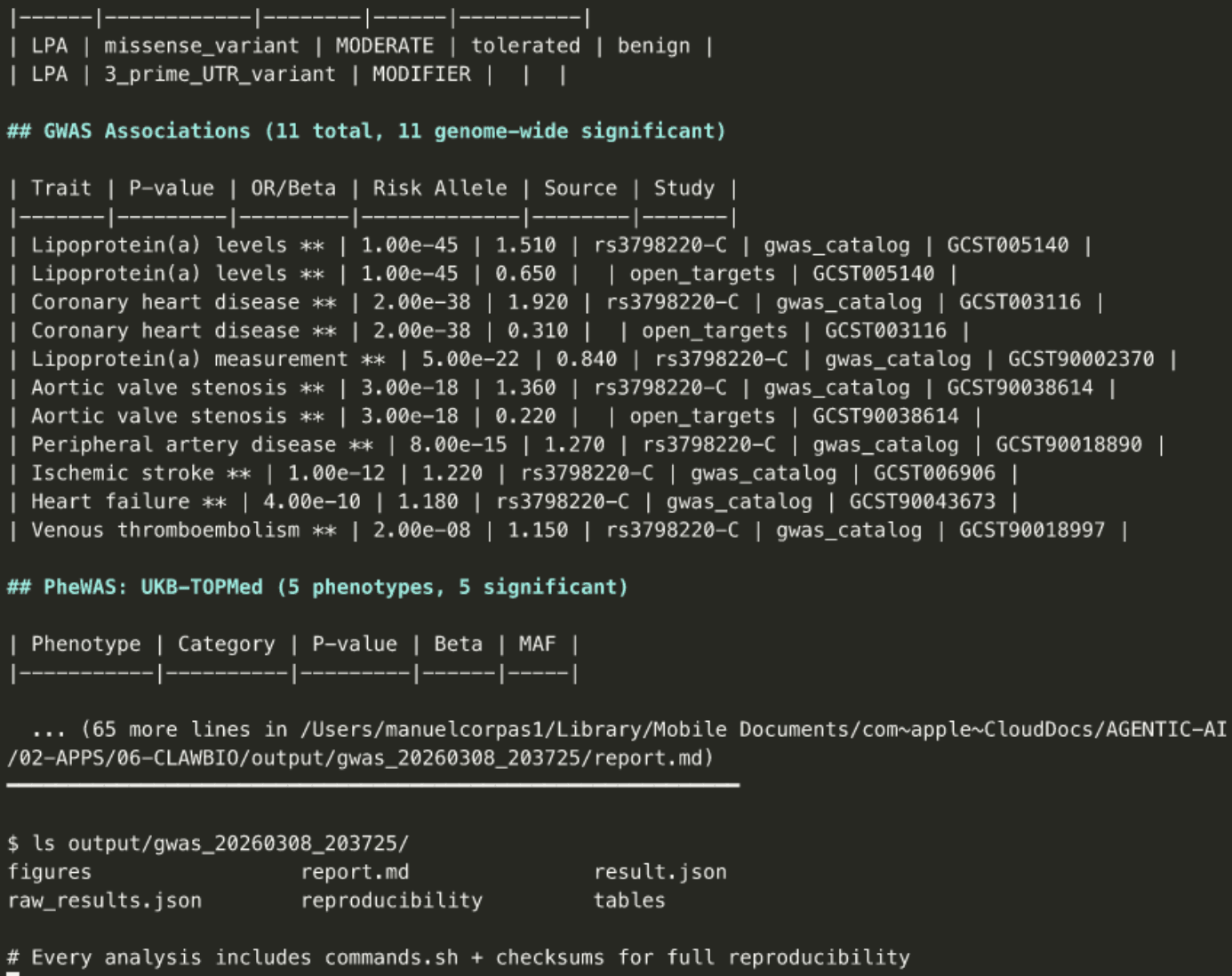
Every run emits a reproducibility bundle: the replay command, environment metadata and output checksums. That is the difference between an analysis you can publish and one you can only describe.
The MCP interface means the same skills work across editors and agents rather than being locked to one vendor’s assistant.
Limitations & things to watch
The published benchmark reports an 88.5% pass rate across tested skills. That is the project’s own figure, and it also means roughly one skill in nine fails its own test – check the leaderboard for the specific skill you intend to rely on.
It is pre-1.0 software, at version 0.6.x at the time of writing, so interfaces can still change between releases. Opensource contributors are welcome.
Local-first shifts the compute and environment setup onto you. There is no managed service to fall back on when a dependency conflicts.
Skill quality varies with who contributed it. A vetted library is better than generated code, but it is not a substitute for understanding the method you are running.
The project is young and centres on one maintainer plus a volunteer community, which is worth weighing before it becomes load-bearing in a production pipeline.
Similar Tools
 DESeq2
Differential Expression Analysis
New2026
SAMtools
Sequence Alignment Data Toolkit
New2026
DESeq2
Differential Expression Analysis
New2026
SAMtools
Sequence Alignment Data Toolkit
New2026
 Biopython
Python Tools for Computational Biology
New2026
Biopython
Python Tools for Computational Biology
New2026
 Bioconductor
R Packages for Genomic Analysis
Bioconductor
R Packages for Genomic Analysis
Do Other Researchers Need to Know About Your Research?
Submit a draft explaining your research, our experts will edit and share it with the world.
- Ground Breaking Findings that Accelerate Research
- Tools and Tricks that Help Researchers
- Advice to Save Time and Money in Laboratories
Reachout to Researchers with Our Extensive Marketing Network
Modern scientific marketing partner built for life science brands