| Votes | By | Price | Discipline | Year Launched |
| Research Rabbit | FREE | Interdisciplinary |
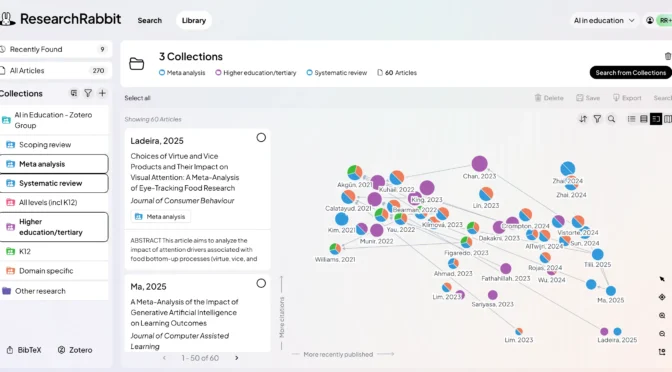
Research Rabbit is a citation-graph explorer that has been free since launch and describes itself, not unreasonably, as Spotify for papers. You seed a collection with a few papers you already trust, and it builds an interactive map of what surrounds them — earlier work they cite, later work citing them, and authors clustered by how their output connects.
What it does
The interactive network view is the reason to use it. Rather than reading a linear list of search results, you see a field’s structure: which papers are hubs, which clusters are distinct, where a line of work went quiet and where it accelerated. Adding a paper to a collection updates the recommendations, so the tool learns the shape of your interest as you work. It also does author-centric exploration, which is often the fastest route into an unfamiliar area — find the two or three groups actually driving a subfield and read them.
Collections sync with Zotero, so discovery in Research Rabbit flows into the reference manager where writing happens.
Where it fits
This is an orientation tool for the beginning of a project, and for finding the gap. Citation-graph navigation surfaces the paper that keyword search misses because it uses different vocabulary for the same idea — a routine failure mode in interdisciplinary work.
Strengths
- Free, with no paywalled core functionality.
- Interactive network visualisation that makes field structure legible at a glance.
- Author and paper exploration from the same interface.
- Zotero integration so discoveries reach your library.
- Email alerts for new work entering a collection.
- Very low barrier to a first useful result.
Limitations
It relies on citation metadata, so it inherits that data’s biases: recent papers are under-connected, and fields with poor indexing map badly. It finds related work but does not evaluate or extract from it — pair it with scite for citation context and Elicit for extraction. Very large collections become visually cluttered, and it is a discovery layer rather than a reference manager, notwithstanding the collections feature.
Verdict
The best free literature discovery tool available, and the first thing to open when entering a new area. Seed it with five good papers and spend twenty minutes exploring before you write a single search query.
Similar Tools
Do Other Researchers Need to Know About Your Research?
Submit a draft explaining your research, our experts will edit and share it with the world.
- Ground Breaking Findings that Accelerate Research
- Tools and Tricks that Help Researchers
- Advice to Save Time and Money in Laboratories
Reachout to Researchers with Our Extensive Marketing Network
Modern scientific marketing partner built for life science brands