
AI Biodesign Accelerator: Moving From Blind Prediction to Guided Experimentation
- From discovering biology to exploring what biology could be
- The core idea: put AI inside the experimental loop
- Experimetal Laboratory Bottleneck
- Moving toward “lab-in-the-loop” AI
- Why multiplex experiments could be one of the initiative’s biggest advantages?
- Traditional biological dataset
- AI-guided experimental dataset
- Why synthetic data is becoming increasingly important in biology
- The Allen Institute is also building toward autonomous AI research
- What AI BioDesign will need to prove
- 1. Can the models learn generalizable biological rules?
- 2. Can experimental throughput keep up with AI?
- 3. Can negative experimental results be captured effectively?
- 4. How reproducible will the results be?
- 5. How will biological safety be managed?
- The real opportunity: discovering the “laws” of biology
- Sources used
Reachout to Researchers with Our Extensive Marketing Network
Modern scientific marketing partner built for life science brands


Allen Institute just announced a new AI Biodesign Collaborative Accelerator in collaboration with University of Washington and Fred Hutch Cancer Center. Following the AIxBio trend, the new accelerator will support building of new open AI models, free datasets (assuming to train AI) and combine it with large-scale wet-lab experiments to accelerate biological research.
AI Biodesign accelerator’s goal is bigger than discovering existing biology: it is to learn the rules that govern biological systems and use them to design entirely new ones. Understanding the rules biology uses to build life will help the potential development of nutritious food, new drugs to treat diseases and neurodegeneration, to enzymes that can break down plastics in the blood stream, to even 2030’s trending biological computers that will hopefully replace silicon based processing.
For the last several years, AI lead by AlphaFold and others models has demonstrated that it can become extraordinarily useful at predict protein structures, identify patterns in DNA, model cellular states, prioritize drug candidates and increasingly generate biological sequences that have never existed in nature. The harder question now is whether AI can learn enough about biology to design new biology reliably. That is the problem the AI BioDesign accelerator is attempting to tackle with access to better models and computational power.
Nobel laureate David Baker, lead scientific director of AI BioDesign proposes a continuous loop in which AI models generate new synthetic biological designs, researchers build and test those designs at scale, and the results are fed back into the models to further train it. Instead of treating experimental validation as the final stage of an AI discovery pipeline, experimentation (both success and failure) becomes part of the intelligence system itself. (Allen Institute)
This distinction may sound subtle, but it represents a potentially important shift in the limits of known knowledge datasets and how biological research is organized. The future of AI in biology may not belong simply to the organizations with the largest models or the most powerful GPUs. It may belong to those capable of creating the fastest and most information-rich design–build–measure–learn loops.
From discovering biology to exploring what biology could be
Biology has traditionally been studied as something we discover by unravelling puzzles nature has set for us. Researchers decode genomes that evolution has already produced. They characterise proteins that exist in living organisms and study cells, pathways and molecular interactions that emerged through billions of years of evolution.
The realisation we have come to is that the number of theoretically possible biological sequences is vastly larger than the fraction that nature has actually explored. We are also beginning to question these same proteins if they are the most efficient way to do a particular function. A protein containing 100 amino acids, for example, has an astronomical number of possible sequences. The best experimental approaches can only investigate a microscopic fraction of that space.
AI BioDesign is built around the idea that the unexplored space may contain a multitude of useful biological functions that evolution never happened to discover. With no lack of new hypothesis thanks to AI, the accelerator will use large-scale experiments to explore this territory and develop reusable models, datasets, assays, reagents and tools. Its stated ambition includes applications ranging from new therapeutics and gene-regulatory systems to enzymes for environmental applications and potentially new forms of biological computing.
What biological systems already exist? -> What biological systems can be designed?
The core idea: put AI inside the experimental loop
The most significant part of the announcement is not any individual model.
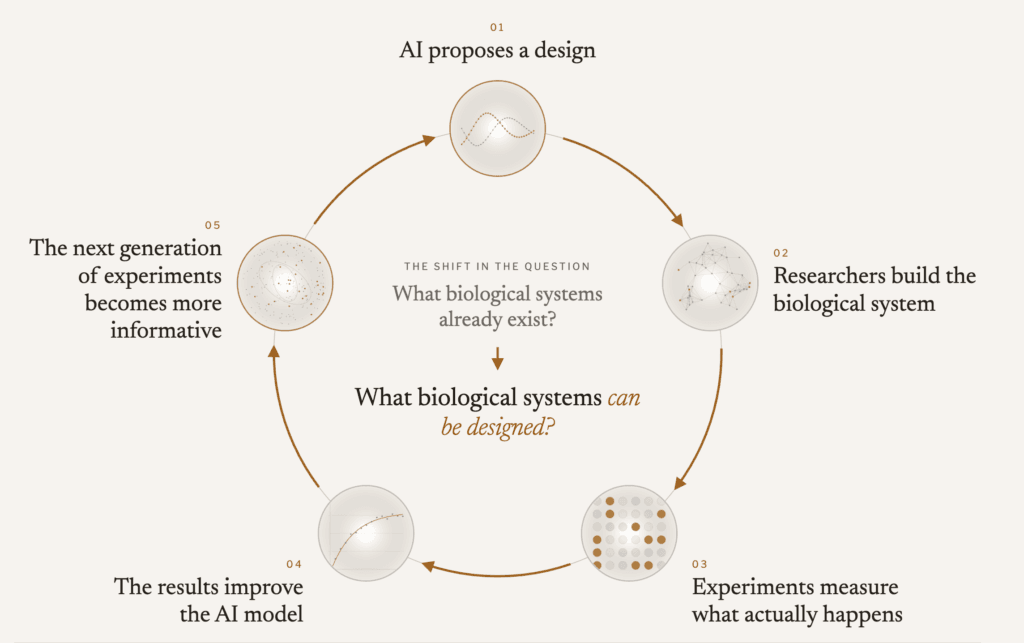
AI BioDesign describes a continuous biological learning cycle:
| Stage | Traditional workflow | AI BioDesign approach |
|---|---|---|
| Hypothesis generation | Scientist-led literature and intuition | Human expertise + AI-generated hypotheses |
| Design | Small number of candidate designs | Large computational exploration |
| Experimental testing | Validation at the end of the pipeline | Experiments continuously guide the model |
| Data generation | Often collected for a specific study | Generated strategically to reduce model uncertainty |
| Learning | Human interpretation between projects | Continuous model updating |
| Output | Discovery or publication | Reusable models, datasets, assays and design tools |
The objective is to move biological engineering away from a predominantly trial-and-error process and toward something more customised and predictable. The Allen Institute describes this as a continuous learning platform for biological design, where each experimental cycle improves the system’s understanding of biological design rules.
That concept is increasingly important because AI models are now reaching a point where computational prediction is no longer the only bottleneck. The bottleneck is the laboratory.
Experimetal Laboratory Bottleneck
The extraordinary success of AI in protein structure prediction demonstrated what happens when machine learning is combined with the right data sets, problem formulation and evaluation framework. But predicting biology and engineering biology are fundamentally different tasks alltogether.
A model may predict that a protein folds into a particular structure. That does not automatically mean the protein:
- can be expressed efficiently;
- remains stable in a real biological environment;
- binds to the intended target;
- avoids unwanted interactions;
- performs its desired function inside a cell or organism;
- can be manufactured;
- or remains safe in a therapeutic context.
This is one of the central reasons experimental biology remains indispensable and will be a bottleneck until either automation speeds up the experimentation process or we design virtual AI agents that can simulate protein or chemical reaction inside a cell/body.
The model’s output is ultimately a hypothesis about reality. The laboratory determines whether that hypothesis survives contact with reality. AI BioDesign’s approach recognises that the experimental system should therefore not be treated merely as a validation layer. Instead, the experiment ends up becoming a data-generation engine specifically designed to improve the intelligence system.
This is a critical distinction. Traditional biological datasets are often observational. Researchers sequence what exists, measure what occurs naturally or characterize variants generated through relatively narrow experimental strategies. AI-guided biology can generate data from deliberately designed perturbations.
Moving toward “lab-in-the-loop” AI
The idea behind AI BioDesign does not emerge in isolation nor is it unique. Multiple organizations are independently converging on a similar conclusion: increasingly capable biological models need increasingly capable experimental feedback systems. One of the clearest examples comes from the Arc Institute and its MULTI-evolve work, where they focuses on a difficult protein engineering problem: identifying combinations of mutations that work together.
A model trained only on individual mutations may identify several promising changes without understanding the bigger picture. But biology is often non-additive. Two individually beneficial mutations may interfere with one another, while a combination of mutations can sometimes produce unexpected synergy. MULTI-evolve combines machine learning with iterative experimental testing to navigate this problem more efficiently. According to Arc Institute’s description of the work, the framework specifically targets the laboratory bottleneck by using experimental measurements to guide subsequent rounds of protein evolution. (arcinstitute.org)
The broader lesson is important. The most useful dataset may not be the biggest possible dataset. It may be the dataset generated by the most informative next experiment. That is exactly where AI-guided experimental design becomes powerful. Instead of randomly testing thousands of random variants, a model can potentially select experiments that maximize learning about the system.
AI BioDesign intends to scale this philosophy beyond individual protein engineering problems and into a broader platform for biological design.
Evolution of AIxBio: Prediction to generative biology
The AI-for-biology field has evolved rapidly. A simplified timeline looks something like this:
| Phase 1: Biological data analysis Machine learning was primarily used to classify biological data, identify patterns and make predictions. Examples: disease classification; microscopy analysis; genomics; biomarker discovery; protein function prediction. | Phase 2: Biological structure prediction AI began solving more fundamental representation problems. Protein structure prediction became the defining example. |
| Phase 3: Generative biology Models increasingly began producing new biological sequences and structures. Instead of asking: “What is this protein?” Researchers began asking: “Generate a protein capable of performing this function.” | Phase 4: Closed-loop biological design AI-generated designs are experimentally tested, with results used to improve future models. AI BioDesign belongs primarily to this emerging phase. |
The transition is not absolute—older approaches will continue to coexist—but the center of gravity is shifting.
A particularly relevant development by researchers at Arc Institute. Evo 2, the large genomic foundation model developed by researchers associated with Arc Institute and collaborators, was trained on biological sequence data spanning all domains of life and was designed to perform both predictive and generative tasks. (arcinstitute.org)
The Evo 2 project has also demonstrated experimentally grounded design work. In one reported proof of concept, designed regulatory sequences were synthesized and tested, with measured chromatin accessibility showing strong agreement with model predictions for the tested designs. More importantly, the Arc Institute has explicitly pointed toward AI lab-in-the-loop experiments as a next stage of development.
Different institutions are beginning to build different pieces of the same emerging research stack:
- foundation models;
- biological representation learning;
- generative models;
- automated experimentation;
- multiplexed assays;
- active learning;
- robotic laboratories;
- computational experiment planning.
AI BioDesign attempts to integrate many of those components into an open scientific accelerator.
Why multiplex experiments could be one of the initiative’s biggest advantages?
AI models improve through exposure to informative data. The problem is that biological experiments can be slow, expensive and difficult to scale. If a model proposes one design and a scientist tests one design, the learning loop remains slow.
The economics change when experiments can test hundreds, thousands or potentially much larger numbers of biological designs simultaneously. AI BioDesign specifically emphasizes multiplex experiments and designed biological sequences and perturbations as part of its strategy. This could allow researchers to generate datasets that are fundamentally different from conventional biological datasets. Consider the difference.
Traditional biological dataset
Researchers collect:
- naturally occurring sequences;
- disease-associated mutations;
- observational measurements;
- variants discovered through evolution or population diversity.
AI-guided experimental dataset
Researchers deliberately generate:
- sequences near the boundary between functional and non-functional;
- competing hypotheses;
- unusual combinations of mutations;
- synthetic regulatory elements;
- designs that maximize disagreement between models;
- variants specifically selected to reduce uncertainty.
The second type of dataset can be dramatically more informative for a design problem and more AI friendly. In machine learning terminology, this begins to resemble active learning. That could become one of the defining characteristics of next-generation biological research infrastructure.
Why synthetic data is becoming increasingly important in biology
AI BioDesign also raises a fascinating possibility: biology may increasingly generate synthetic experimental data specifically for AI. Most current biological AI systems are trained primarily on historical data and still millions are poured into studying natural proteins such as venoms to find the next Ozempic.
But historical data has limitations and we are reaching the limits of what nature can teach us. Scientific datasets were not always designed for machine learning either.
Existing datasets can contain:
- sampling bias;
- incomplete coverage;
- inconsistent protocols;
- missing negative results;
- weak representation of failed designs;
- limited exploration of unusual biological states.
An AI-guided experimental system can intentionally generate data where the model is weakest. Imagine two models disagreeing about whether a protein design will function. That disagreement is valuable.
Instead of randomly generating another experiment, researchers could specifically test the design that would provide the most information about which model is correct. Over time, the system could concentrate experimental resources on areas where scientific uncertainty is highest. This creates a different relationship between AI and experimentation. The AI does not replace experimental biology. In that sense, AI BioDesign is not just a biomedical initiative. It sits within the broader emerging field of programmable biology.
It creates a reason to perform better experiments.
The Allen Institute is also building toward autonomous AI research
The new accelerator should also be viewed in the context of another important Allen Institute development. Earlier in 2026, the organization announced a collaboration with Anthropic focused on developing autonomous AI agents for bioscience research. The stated objective is to build systems capable of helping scientists explore much larger numbers of hypotheses and datasets than would be practical through conventional workflows. (Allen Institute)
Together, these initiatives point toward a larger transformation in scientific infrastructure.
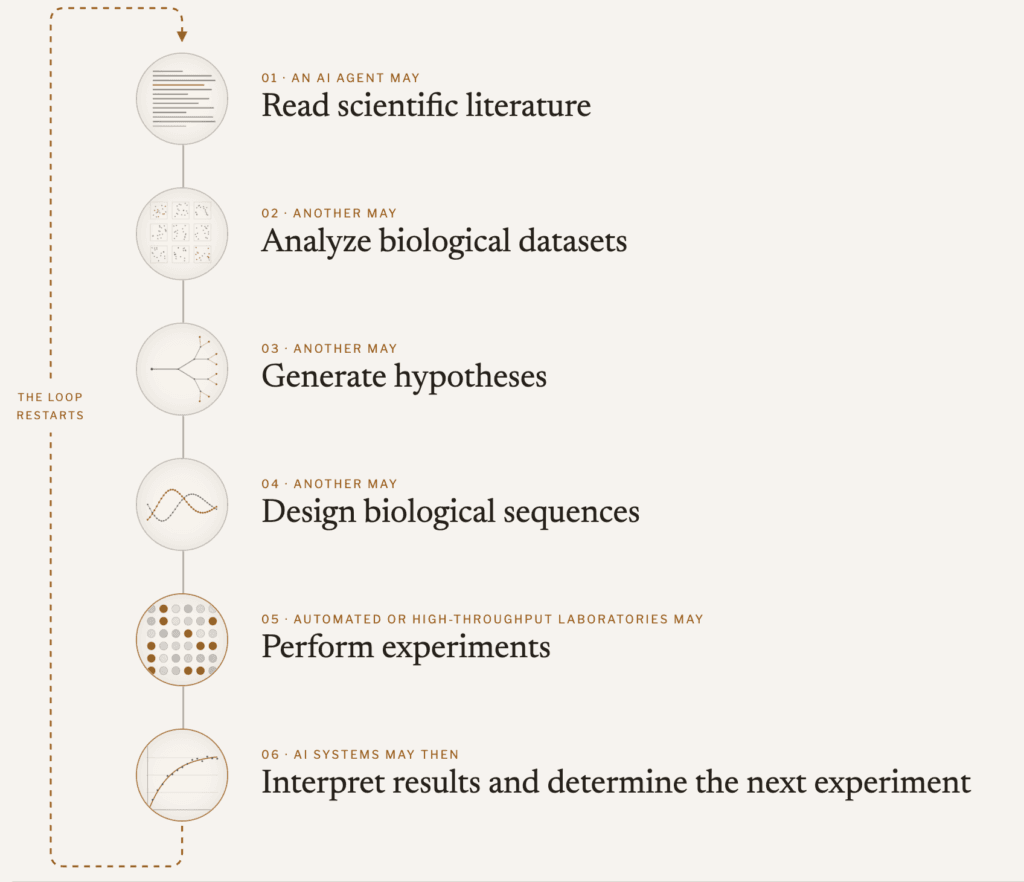
That is the long-term architecture many organizations are now moving toward.
The scientist does not disappear from this system.
Instead, the role increasingly shifts toward:
- defining objectives;
- establishing constraints;
- interpreting unexpected results;
- evaluating scientific plausibility;
- overseeing safety;
- deciding which problems are worth solving.
The experimental system becomes increasingly autonomous, but scientific judgment remains essential.
What AI BioDesign will need to prove
The Allen Institutes’ initiative is ambitious, but there are several important challenges.
1. Can the models learn generalizable biological rules?
A model may become extremely good at optimizing a specific assay without learning principles that transfer to other biological systems.
For AI BioDesign to have broad impact, its discoveries will need to generalize beyond individual experiments.
2. Can experimental throughput keep up with AI?
We have seen that generative AI can produce millions of candidate sequences. A laboratory cannot test millions of designs with equal ease. This creates a new bottleneck which even the most automated laboratory can’t solve.
The value of the system will depend heavily on:
- multiplexed assays;
- experimental automation;
- intelligent prioritization;
- efficient synthesis;
- measurement quality.
The AI must not simply generate more possibilities than the laboratory can evaluate. It must help determine which possibilities are worth testing.
3. Can negative experimental results be captured effectively?
Failed experiments are often scientifically valuable but historically underrepresented in published datasets. For AI-guided biological design, a well-characterized failure can be as useful as a success. However, increased weightage to failed experiments can lead to the AI optimising for failure, rather than success.
A major advantage of a dedicated research platform could be the systematic collection of:
- successful designs;
- failed designs;
- ambiguous results;
- context-dependent behaviors.
These data could dramatically improve model calibration.
4. How reproducible will the results be?
Biological experiments are sensitive to:
- cell lines;
- environmental conditions;
- protocols;
- instrumentation;
- reagent variation;
- laboratory-specific effects.
- consumables
A model trained on one experimental environment may not perform identically in another. Open protocols, standardized assays and reproducible benchmarks will therefore be as important as the models themselves.
5. How will biological safety be managed?
As AI becomes better at generating novel biological sequences, safety and governance become increasingly important.
There is a major difference between designing a useful enzyme and generating biological systems with unintended capabilities.
Responsible biological design will require appropriate screening, governance and institutional oversight.
The real opportunity: discovering the “laws” of biology
Perhaps the most ambitious phrase in the Allen Institute’s announcement is the idea of learning biology’s underlying design rules. Physics has equations, Engineering has principles, Software has abstractions. Biology often appears more difficult because its rules emerge from enormous numbers of interacting components. But researchers may increasingly be able to identify predictive regularities.
Over time, the collection of those answers could become something resembling an engineering toolkit for biology. That is the deeper ambition behind AI BioDesign and what personally excites us. Not merely generating a better protein. Not merely discovering a new molecule. But developing a progressively more predictive understanding of what biological systems can be made to do.
The initiative’s success should therefore not be judged solely by the first model it releases or the first molecule it designs. The more important question is whether it can establish a scalable system in which:
AI generates hypotheses
→ experiments test them
→ data improves the models
→ better models design better experiments
If that loop becomes sufficiently fast and reliable, it could fundamentally change the economics of biological discovery. The next generation of biological AI will not be built only by training increasingly large models on increasingly large datasets. It will be built by creating a conversation between computation and experimentation. AI BioDesign is one of the clearest institutional bets yet on that idea.
The Allen Institute, University of Washington and Fred Hutch are effectively building an experimental intelligence engine: a system designed not only to understand the biological world that already exists, but to systematically explore the biological world that might be possible.
Whether the initiative ultimately produces breakthrough therapeutics, industrial enzymes, new genetic tools or entirely new biological computing architectures remains to be seen. However, its underlying model is already shaping the direction of the industry. The future is a continuously learning system in which the model, the experiment and the scientist become parts of the same discovery engine.
And if that approach works, the most important output of AI-powered biology may not be an answer.
It may be the ability to ask—and experimentally test—better questions at a scale that biology has never seen before.
Sources used
