
Novo Nordisk is Putting Claude Directly into Pharma R&D
Reachout to Researchers with Our Extensive Marketing Network
Modern scientific marketing partner built for life science brands

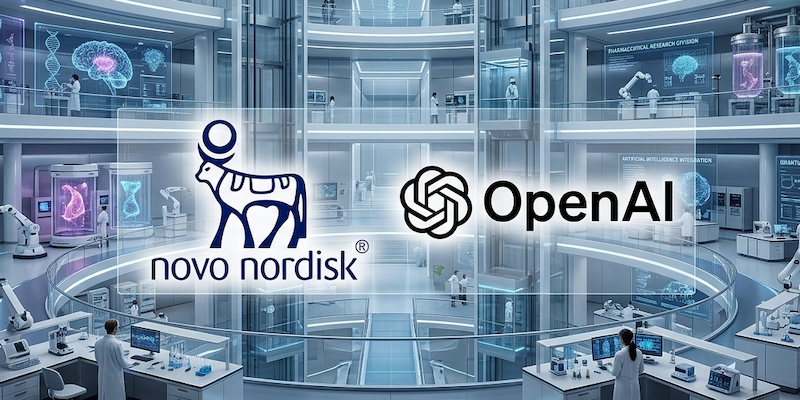
Novo Nordisk has spent several years experimenting with AI across pharmaceutical development just like most other multinational pharma companies. On September 16, 2026, Novo’s management announced its latest and potentially broader move: a collaboration with Anthropic that will put Claude and Claude Science directly into Novo’s research and development workflows.
The partnership goes beyond using Claude as an enterprise chatbot and research tool. Novo says the two companies will work together on drug-discovery challenges identified by Novo’s scientists and computational teams, develop targeted solutions for specific scientific problems and workflows, and use Claude Science to strengthen scientific reasoning in R&D. The collaboration also includes agentic software engineering but no partnership announcements related to the actual wet lab being setup by claude.
That makes the partnership interesting because Novo already has extensive experience deploying AI. Anthropic previously highlighted Novo’s NovoScribe, an AI-powered documentation system built using Claude models on Amazon Bedrock, Claude Code and MongoDB Atlas. Novo reported that clinical documentation workflows that previously required more than 10 weeks could be reduced to around 10 minutes, with review cycles falling by about 50%. That earlier deployment focused heavily on documentation and development workflows. The new agreement moves Claude further upstream into scientific R&D.
NOVO’S AI PROGRESSION
Documentation
Clinical and regulatory workflowsSoftware
Claude Code and internal developmentScientific reasoning
Biological research and drug discoveryAgentic R&D
Specialized scientific workflows
The near-term opportunity lies elsewhere: compressing the research cycle. Drug discovery requires scientists to connect evidence from genetics, molecular biology, structural biology, chemistry, pharmacology and clinical research. Much of that information sits in different databases and software systems. A capable scientific agent can potentially move between those sources, construct analyses, write computational workflows and generate structured hypotheses.
The new partnership pushes Claude closer to the core research process. The company has not publicly disclosed specific drug candidates or therapeutic programs that Claude will develop under the new collaboration. That matters because the announcement should not be interpreted as evidence that Claude has already discovered a new Novo medicine.
Anthropic’s Claude Science was designed for precisely this type of work. The platform combines scientific tools, computational resources and auditable outputs, allowing researchers to work across databases, code and analysis environments from a unified interface.
Novo’s partnership therefore fits a much larger industry trend of pharmaceutical companies are moving from AI as an analytical tool toward AI as an operational layer for R&D.
Novo already has a relationship with Ginkgo Bioworks that is moving in the physical direction. On September 15, Ginkgo announced that it would build an autonomous laboratory at Novo’s new U.S. R&D site in Waltham, Massachusetts. The system will use Ginkgo’s Reconfigurable Automation Cart architecture and Catalyst software.
That development makes the Anthropic partnership even more interesting. One collaboration potentially provides AI reasoning. Another provides automated experimental infrastructure. The convergence of the two could eventually create an R&D environment where AI proposes experiments, autonomous laboratories execute them and the resulting measurements return directly to computational systems.
Related Labcritics coverage:
GPT-Rosalind · AI Biodesign Accelerator · Lab Automation
